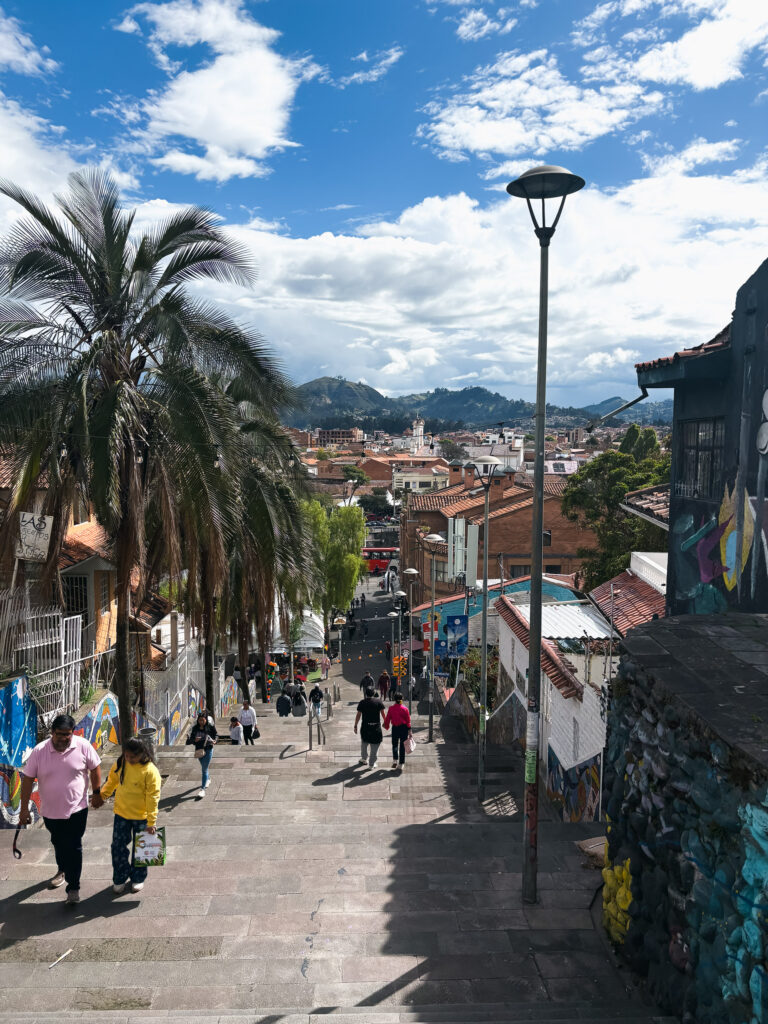
The one thing I’ve learned about Mérida is that you can’t really capture it with just a list of things to do. It is, above all, a very nice city to be — and so the biggest “thing to do” is the city itself.
Mérida has a way of making you forget, even temporarily, your travel to-do list. I felt compelled to simply wander around, exploring the welcoming streets that inevitably lead you to art galleries, cosy cafes, and shops selling traditional local textiles (in particular huipil, white tunic-like dresses with embroidered flower patterns, typical of the Yucatecan Maya).
The city also surprised me architecturally. Besides the low-rise and colorfully painted buildings that are typical of Mexican colonial cities, Mérida features beautiful mansions from the early 1900s and gorgeous Art Deco buildings with swirling decorations and cast iron fencing. One of its stately avenues lined with classic mansions even reminded me faintly of Seville in Spain (just a less polished version).

But aside from enjoying its peachy atmosphere, Mérida does also has many compelling attractions to specifically target, which I will share in a moment. It also sits at the bullseye of a whole dart board full of places to see in the Yucatán, making it a perfect hub for exploring the region.
No matter which direction you go — north, south, west, east — you will hit upon interesting day trips within about an hour’s drive. These include some of Yucatán’s most stunning cenotes (natural sinkholes), lagoons with colonies of bright pink flamingoes, and Mayan ruins almost comically uncrowded compared to Chichen Itza.

In this guide I’ve put together everything you need to know to get the most out of the Yucatán Peninsula’s cultural and historic gem. My impressions are based on two seperate visits; my first introduction to Merida I had as a backpacker travelling all around Mexico, while my recent re-visit was part of a family trip through the Yucatan Peninsula.
Where to stay in Merida
Mérida is one of Mexico’s safest cities, making it an ideal entry point for experienced or novice travellers alike. That said, the vibe can shift suddenly and unannounced between different neighborhoods, so it’s worth targeting a specific area to base yourself in.
For instance, just south of the main square the streets switch from romantic to chaotic, especially around the main market, Mercado San Benito. The crowds waiting to hop onto minibuses, the jumble of local discount shops, and even the occasional pay-by-the-hour love hotel found here may be interesting in terms of urban exploration, but it’s probably not where most visitors want to anchor their stay.
Instead, here are several ideal areas to pin for your accommodation search.
Centro Histórico (Historic Center)
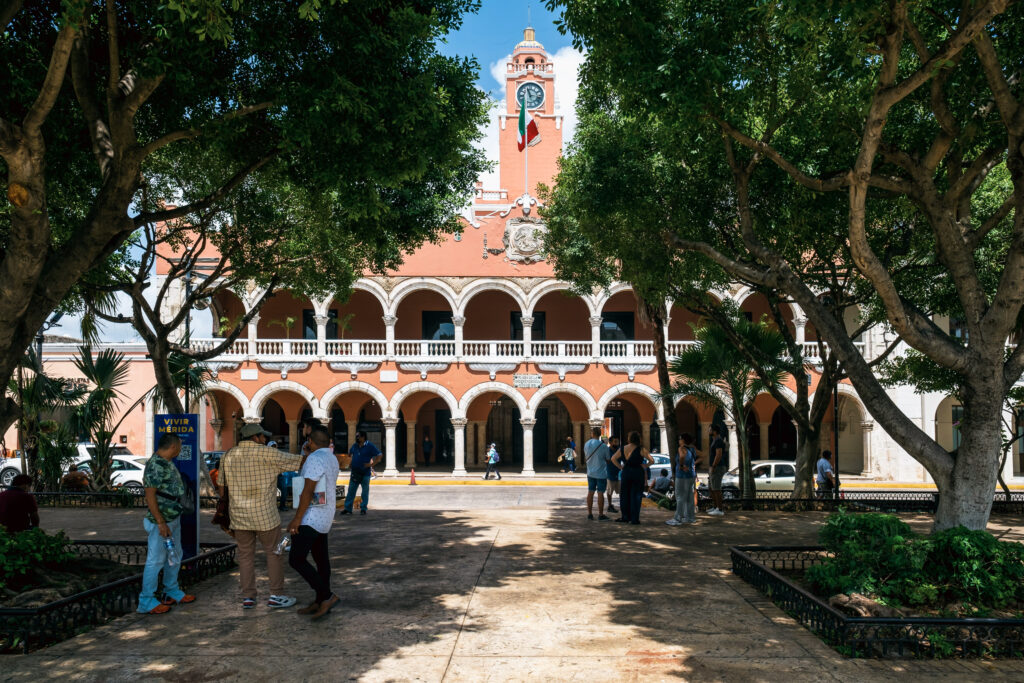
This is the colonial heart of Mérida around its main plaza. Here you’ll find arched arcades, theatres, historical mansions with courtyards, and the impressive Catedral de San Ildefonso. It’s the most convenient base for first-time visitors since you’re within walking distance of many attractions.
On the downside, it’s quite busy, it’s difficult to park (if you’re by car), and it can be less suited for a budget stay. Restaurants and hotels tend to be more upscale.
- Piedra de Agua Merida – this is the closest you can get to the city’s central grid. Its standout feature is the rooftop terrace restaurant overlooking the cathedral, where you can dine with one of the most iconic city views.
- CIGNO Boutique Hotel – a refined stay set within a restored 19th-century mansion, about a 10–12 minute walk from Plaza Grande.
- DECU DOWNTOWN – probably the most “effortless” base in Centro. It leans towards clean design, symmetry, and calm functionality for those who want practical, central access.
- Casa Lorena – a practical city Airbnb with open spaces and a calm residential feel, best suited for couples or solo travellers
North of Plaza Principal (Parque de Santa Ana)
I’ve stayed in this area twice and recommend it for a wonderfully ‘balanced’ area — it’s just 10 to 15 minutes walking from the main square, but also has more of a local/artsy neighborhood feel.
I like that it has a good mix of both trendy and local restaurants (there is even a food market on Parque de Santa Ana for cheap eats). It’s well-connected to the historical center, especially via Calle 60 which becomes pedestrianized at night.
As you get closer to Paseo de Montejo (north/east), Mérida’s grand boulevard lined with classic mansions, the accommodations become more boutique/luxury. South and west of Santa Ana park, you’ll also find more budget options.
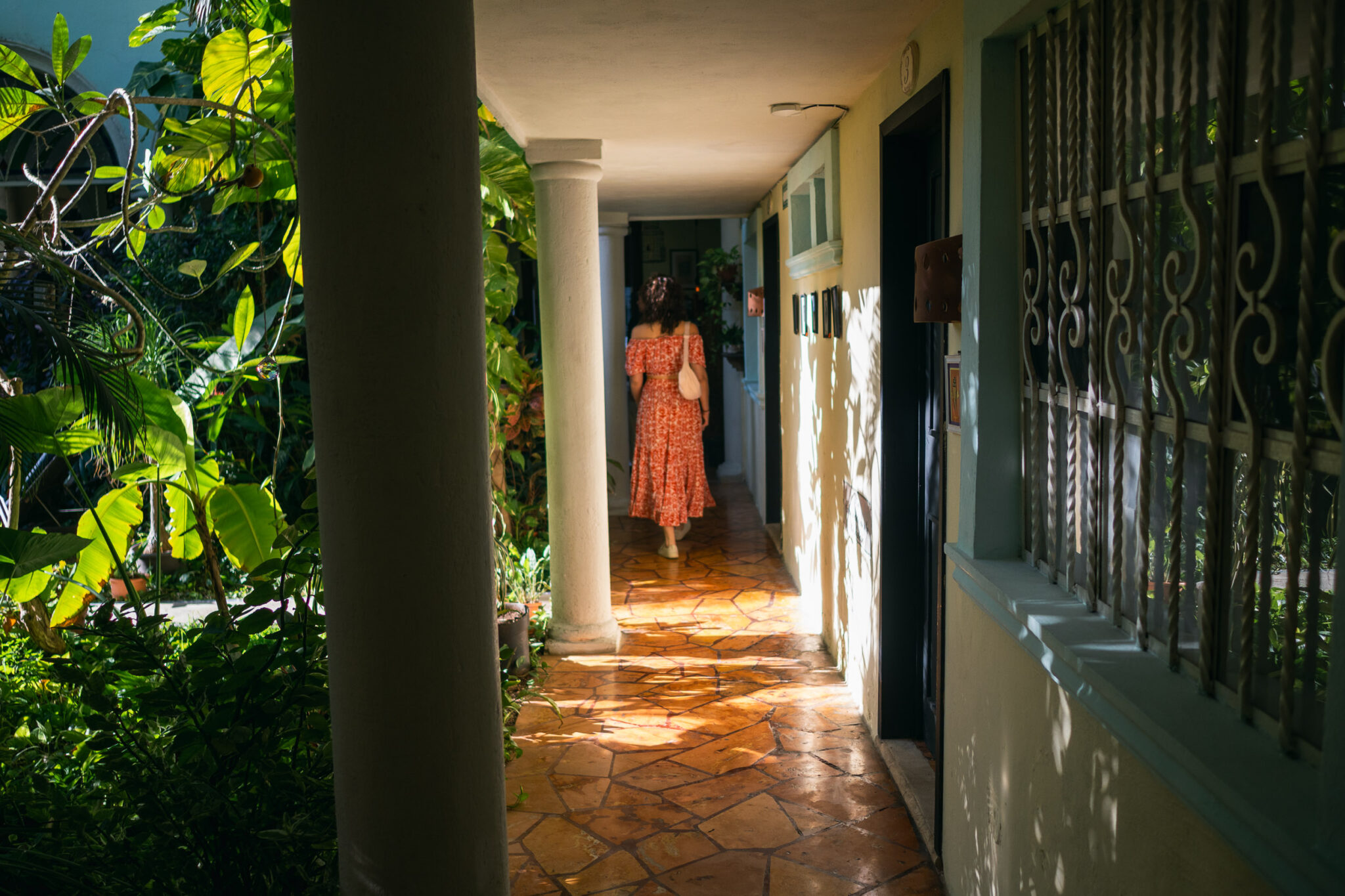
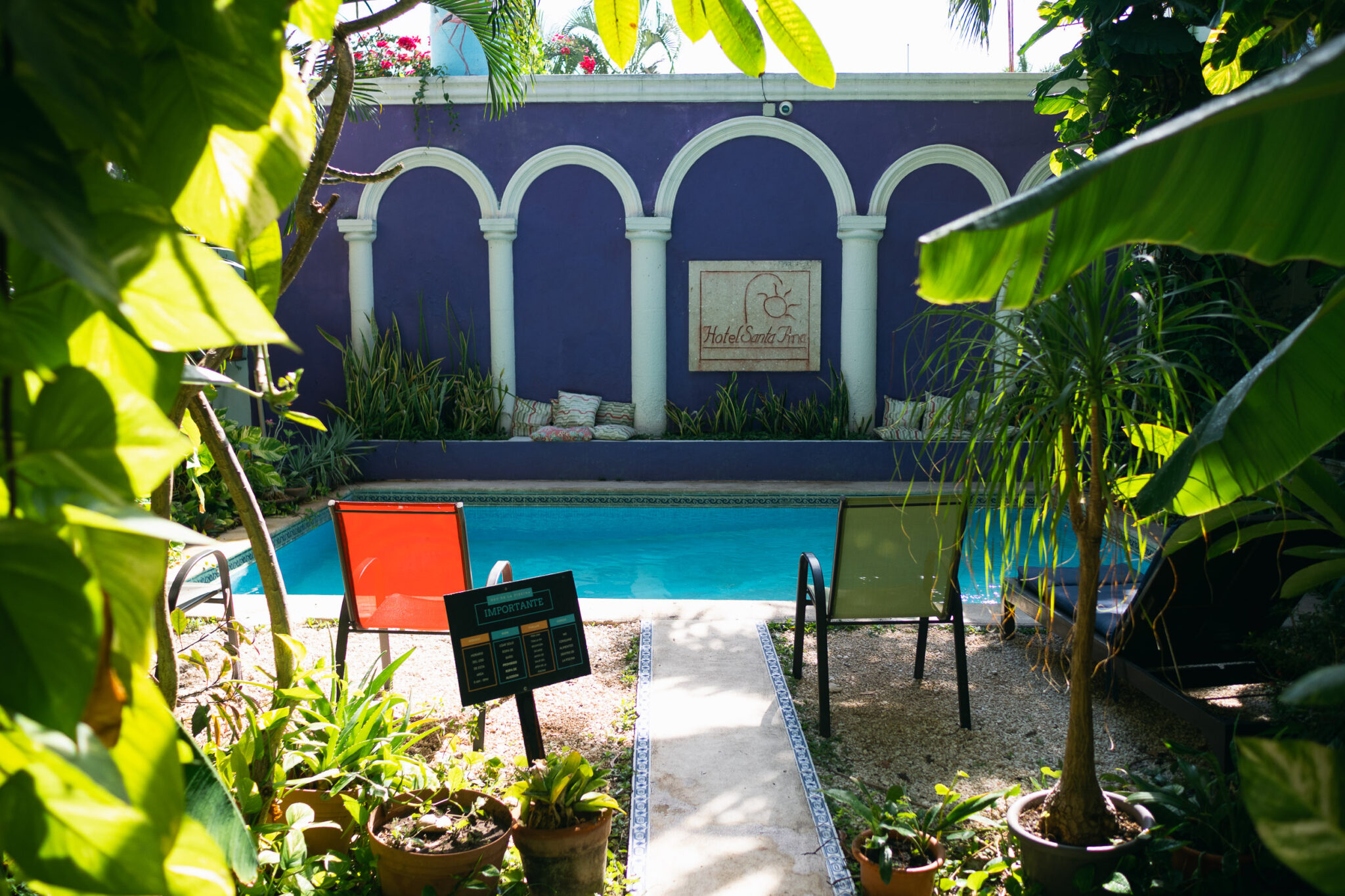
- Hotel Santa Ana – This is where I personally stayed. A fantastic, friendly, and good value hotel, with all rooms connecting to a green courtyard with a pool, reminding me a bit of a Moroccan riad.
- Che Nómadas Mérida Hostel – I stayed here a bunch of years ago when I first explored Mérida as a solo backpacker — and they are still going strong! The activities like salsa dancing and yoga ensure a fun, social stay.
- Casa Pantera – A stylish and chique Airbnb home rental from a Superhost
West of Plaza Principal (Parque de Santiago)
Passing through this area several times it struck me as another ideal middle-ground area where I’d love to stay on a future visit. It’s Mérida’s most authentic residential barrios with many pastel-colored colonial-era homes, while being just a stone’s throw from the historical center.
- Casa Luna Nueva – (editor’s pick!) designed more like a private architectural residence than a hotel. It’s expansive, cozy, and deeply residential, just steps from Santiago square but still super private.
- Casona Santiago 59 – a nice city Airbnb centered around light-filled interiors, minimal tropical design, and open social spaces, perfect for couples or families
- Viva Merida Hotel Boutique – probably the most Yucatecan stay in the list… A colonial guesthouse layered with warm textures, colourful details, and a playful character
Tip: Being far from the coast, Mérida gets a lot hotter than other parts of the Yucatán Peninsula. Combined with high humidity it can lead to a rather sweaty stay. Booking a hotel with a swimming pool is a great idea for cooling off!
11 Things to see & do in Merida
Most guides I’d read made Mérida sound like maybe a 2-day stopover — see the main square, maybe do a walking tour, then move on. But I’d really been undersold on this city. I soon realized I could easily spend a week here and barely scratch the surface.
Here are some of the best things to do in and around Mérida, mixing city exploration with exciting day trips into the region.
1. Sample Yucatán’s signature dishes
Compared to culinarily celebrated regions such as Oaxaca and Puebla the food scene in the Yucatán is maybe a little less explored and mysterious. However, it is home to some must-try dishes. You can find these on menus across the Yucatán, but in Mérida it’s especially easy to sample them all in one place.
An oft-tipped go-to restaurant is La Chaya Maya, which offers traditional dishes from around the peninsula. I went to its sister location La Chaya Maya Casona, which has an open-air courtyard and a band playing at night. It’s a bit of a tourist hotspot, though the prices are fair and the service is good. A taster menu will give you four dishes to try, which I thought was a rather meat-heavy affair, but it was great to be able to sample everything.
My favorites were Cochinita pibil, slow-roasted pork that is marinated in citrus juices, as well as Relleno negro, a signature dish featuring chicken or turkey in a rich, dark broth. It looks like mole from Oaxaca, the sauce also being pitch black, though with very different flavors.

Those into street food will have a plethora of options. The ancient-rooted dish of Papadzules is a forever popular one (corn tortillas filled with egg, tomato, and chile), while panuchos is another tasty snack that can be picked up virtually anywhere (small tortillas filled with meat, avocado, black beans, and other tasty fillings).
If you’re travelling on a budget or simply curious about the street food, the Mercado Santiago is a good place to look.
📌 That said, we’d recommend booking this food tour if you really want to get under the skin of the city’s food culture. One standout is that it takes you to hidden market corners you’d likely never find alone and leaves you confident enough to go back by yourself. Check it out on Airbnb Experiences.
2. Explore the Museo Palacio de la Música
This highly interactive museum explores the full history of Mexican music and all its influences — from the very first Mayan flute melodies up to the complex modern era.
If I had to rate this museum I would easily give it a 10/10 — it’s insightful, engaging, and covers a unique topic beyond the typical anthropological museums.


I’m much more familiar with the genres that developed in the United States, so it was fascinating to learn of the many musical branches that emerged in Mexico, which mixed indigenous, African, and European traditions (from the Spanish conquerors and later waves of European immigrants).
It’s almost like discovering another civilization’s whole other ‘tech tree’ you were unaware of. The final rooms focus on the impact of radio and cinema on Mexican music and I loved sitting in the mock movie theatre watching clips spanning over a century of Mexican films soundtracks. Again, it felt like I was revealed a parallel cultural history different from the familiar Hollywood timeline.
As you can probably tell, I’m a big fan of this museum. If you’re into the subject matter, you can easily spend 2 or 3 hours here. The air-conditioned rooms make it a great activity to avoid the midday heat.
3. Visit Uxmal: a quieter but equally stunning rival to Chichen Itza
Think Chichen Itza is the only Mayan site worth visiting? Think again.
I’ll just say it: the grand, sprawling, and spectacularly detailed structures at Uxmal are as impressive (if not more so) than Chichen Itza… while receiving nearly 10 times fewer visitors. The mind boggles how such an impressive site could qualify as a ‘hidden gem’, but such is the sheer tourism concentration in the Yucatán.


What sets Uxmal further apart is its showcase of Puuc Architecture, a refined style characterized by smooth walls and elaborate stone mosaics. Its distinctive main pyramid is 35 meters (115 feet) tall, taller than Chichen Itza’s iconic Temple of Kukulcan.
I had expected Uxmal to be a modest alternative, trading some wow-factor for a calmer experience. It was indeed very calm and had no annoying vendors at all, but I was actually blown away by how impressive the site is.
A certified guide walks you through Uxmal, the architecture, the Rain God Chaac, and why this place sits at the pinnacle of Puuc style. After that, 2 cenotes (one open-air, one cave) and lunch cooked by a local Mayan family.
✅ Overall vibe check: Nature + archeological depth. Small group, certified guide (diver, freediver, speleologist, $75/person.
Uxmal is located about an hour’s drive south of Mérida, making it an essential day trip.
I recommend exploring with a guide if you can. Ours gave us lots of interesting insight, knew the best photography spots, and even showed us some sleeping bats that were hiding inside the rooms. You can try to find a freelance guide at the entrance, or book an organized trip from Mérida to be assured of a high-rated, English-speaking guide.

4. Learn about cocoa’s Mayan origins
Did you know the word cocoa actually comes from the Mayan kakaw — and that it was the Mayans who cultivated it and popularized it in an early form of chocolate?
Right next to Uxmal is an interesting museum called Choco-Story (there is also a sister location in Valladolid) that sheds light on cacao’s origins. While the plant comes originally from South America, it was the Mayans who considered it a divine creation and who turned it into a spicy brew often mixed with chili, maize, and vanilla.

My 4-year old daughter was especially into this part, busily experimenting with different combinations of flavors and enjoying the process of stirring her very own hot cocoa.
This partially outdoors museum has a number of displays but it’s also interactive, letting you take part in a Mayan ceremony and even mix your own cocoa drinks. It’s also a bit of a mini-zoo with several animals including jaguars, making this a great stop after you’ve seen the ruins.


5. Catch one of the 3 free weekly shows
Shifting back to the city itself, let’s cover some more things to do within Mérida.
When I looked at lists of things to do in Mérida I saw some mentions of street performances. What I didn’t realize is that every week there are 3 different shows in different plazas that take place at night. For the first two events you may want to arrive a little early, as the neighborhood parks quickly fill up with spectators.

This is the schedule:
- Tuesday Night: Dancing at Santiago Park
A big band music (Danzón) performance where you’ll see local seniors dressed to the nines dancing under the stars. - Thursday Night: Serenata at Santa Lucía Park
Traditional Yucatecan guitar trios and folk dancing. This park is surrounded by restaurants, so you can book a table at La Chaya Maya (Casona) or Apoala and watch the show while you eat. - Friday Night: Pok-ta-Pok (Mayan Ball Game)
Held right in front of the main Cathedral. They reenact the ancient Mayan ball game with fire and body-paint. It’s dramatic, loud, and thrilling.
6. Shop for traditional Mayan textiles (&
handmade Yucatán hammocks)
While you wander the streets, you will quickly notice the many traditional dresses, suits, shawls, and hammocks for sale in the shop. These are actually not cheap ‘Made in China’ goods, but local products woven in traditional Mayan styles.

Before arriving I was discussing with my partner how our new garden really needed some hammocks. Little did we know… Mérida is the hammock capital of Mexico!
Some shops specialize just in hammocks and offer them in virtually every color. They’re typically made in a traditional diamond weave from either cotton or nylon.


In small villages in the Yucatán you can buy hammocks directly and more cheaply from the producers. Otherwise Mérida is considered the best place to shop for them. To this day, many locals still sleep in hammocks rather than beds — it’s a Mayan tradition going back a thousand years.
Shops selling huipiles or ternos, traditional embroidered dresses or blouses, are also very typical of Mérida. You can find all of these textiles sold at Mercado Lucas de Gálvez, Mercado de Artesanías García Rejón (a dedicated crafts market), as well as the Casa de las Artesanías.
7. Gran Museo del Mundo Maya de Mérida
Okay, so this museum oversells itself a little with its name. The “Grand Museum of the Mayan World” is rather good, but maybe not as big as you’d expect. While not quite a must-visit, it is a worthwhile sight if you have the time.

It’s a bit in a weird location, 20 minutes driving from the center among shopping malls and a Costco, hidden within a towering building that feels hostile to pedestrians. But once you find your way in, it’s a well-designed series of exhibits covering Mayan culture. Signs are in Spanish, English, and Maya and most rooms include interactive features.
Just to set expectations, while a fairly big collection of artifacts is displayed, the museum doesn’t just focus on the ancient Maya. However, thematically this is actually its strength: the point is to show that Mayan culture is alive and visible today.


For the most impressive pre-Columbian artifacts, head to the epic anthropology museums in Mexico City or Xalapa, Veracruz. But for a broader context on the Maya, this museum is worth visiting and may help you better frame a visit to one of the archeological sites.
8. Stroll past Mérida’s old mansions
Mérida’s most elegant boulevard, Paseo de Montejo, runs north from the historic center and is lined with palatial mansions from the early 1900s. These were built during the henequen boom — when Yucatán’s “green gold” (sisal fiber used for rope) made a handful of families extraordinarily wealthy.

To get a taste of the art nouveau and art deco elegance, I suggest starting a walk at the Monumento a la Patria (a massive monument at the north end of the avenue) and strolling south toward the center. Some mansions are now banks or offices, others have been converted into hotels or cultural spaces, while a few remain private residences hidden behind wrought-iron gates.
The real highlight is Casa Museo Montes Molina, one of the few grand mansions you can actually enter. It’s been preserved almost exactly as it was in the 1920s, complete with original furniture and decoration. Guided tours are offered in English and Spanish.
9. Swimming in Cenotes near Mérida (and how to find the hidden ones)
The area around Mérida is wildly rich in cenotes, the natural sinkholes the Yucatán Peninsula is famous for. Swimming in the natural pools surrounded by jungle is a truly special experience and Mérida is the perfect base to do it.


While Valladolid further east is the “Instagram” capital of cenotes with some of the most viral places nearby, the ones near Mérida offer a much more lowkey, rustic, and local experience. Without the Cancun day tripper crowd, it can feel like you have the cenotes almost to yourself.
The cenotes are particularly clustered south and southeast of Mérida. Some of the prominent ones include Cenote X’batun, Cenote Yaal Utzil, and about a dozen great ones near the town of Homún. They are typically well set up, even the less famous ones, with facilities such as showers and changing rooms. You are always asked to shower beforehand to wash off any sunscreen or mosquito spray that could damage the ecology.
Want to go beyond the van tours? Then grab a bike and let a Maya nature guide lead you through jungle trails to three cenotes well off the usual tourist circuit — a half-day that’s equal parts adventure and cultural immersion.
Along the way, your guide will walk you through the local plant life, the landscape, and the medicinal traditions the Maya have long drawn from it. Book this tour for on Aibnb Experiences.
If you have your own transportation, my tip is really to just type in ‘cenotes’ on Google Maps and look at reviews. This is how I discovered some lovely off-the-beaten-path options including X’batun, where your ticket also gives you access to the stunning Cenote Dzombacal a 10 minute drive further.
If you’re by public transportation, I suggest taking a collectivo minibus to Homún, from where you can easily arrange tours to multiple cenotes or reach some of them yourself on foot.
10. Drive the Ruta Puuc (or create your own route)
If the ruins of Uxmal haven’t yet quenched our thirst for Mayan archeological sites, there is still a whole collection to explore, conveniently strung together in a driving route known as the “Ruta Puuc”.
This is a very well-promoted tourism route, though I must say it requires dedication. As fascinated as I am with Mayan history, visiting at least 5 sites on a single day (or in 2 days, as is often recommended) would give me some serious Mayan fatigue.
Uxmal is the crown jewel and can by itself take up half a day. The full Ruta Puuc includes Kabah, Sayil, Xlapak, Labná, Oxkintok, and two different caves, which is quite a buffet. Realistically, I see it more as a promotional umbrella for various sites than a route you have to follow to a tee. Either do it slowly, or cherry pick.
I recommend taking a custom approach: maybe add two or three ruins that strike your interest, stop at a hacienda or the aforementioned Chocostory, and tackle some cenotes on the way back (Cenote X’batun and Cenote Kankirixche are halfway between Ruta Puuc and Mérida).
This would give a more varied route that isn’t only centered on ruins, though if you’re an archeology aficionado you may disagree!
11. Mérida’s most surreal day trip: pink lakes & flamingos
There are several places along the north coast where you can see a ‘pink lagoon’, owing to the local salt-making industry here. The light pink tones are the result of rare bacteria and algae that live here, which is a knock-on effect of the high concentration of salt found in these waters.
Personally, I went to see this at Rio Lagartos, starting my trip from the town of El Cuyo. But if I were to plan it from Mérida, I would hit up Xtampú instead, which is a much shorter 1-hour drive from the city.
Xtampú was once an unassuming fishing village hidden away from the world. However, it has since become one of the most Instagrammable places to visit in the region, much like the town of Las Coloradas located further east that I visited.


Now, I’ll be honest: if you drive out here purely for a photoshoot, you might leave feeling underwhelmed. The lagoons are in reality very pink even without filters, though there isn’t much to “do” at these salt flats themselves other than walk the embankments and maybe buy some local salt.
However, it gets a lot more interesting when combined with a tour of the nature reserves. I drove a quad-bike through narrow dirt roads between the lagoons and the wild coast, witnessing huge flocks of bright pink flamingoes along the way. Seeing a big group lift off and fly to the horizon was a sight that is forever imprinted into my mind.
My partner commented on how surreal our trip was in this quite remote place, feeling like we were inside our very own nature documentary. After this unique experience, the pink lake felt like the well-earned icing on the cake.
Expect to see rare birdlife (except for flamingos, which there’ll be a lot of), close-up encounters with crocodiles in Rio Lagartos, and time to unwind at Playa Cancunito, an unspoiled stretch of coast often considered one the most beautiful beaches in Yucatan.

Note: the lake loses its pink color during the dry season (May–September). For flamingos, visit March to June when thousands gather in the mangroves, or October to February for large flocks.
The logistics essentials
Getting to Mérida
Mérida’s international airport (Manuel Crescencio Rejón Airport) has direct flights from several US cities including Miami, Dallas, Houston, and Atlanta, as well as connections from Mexico City. From Europe, you’d typically connect through a US hub, Mexico City, or Cancun.
From Cancún, the most common arrival point for Yucatán travelers, you have a couple of options. The quickest and easiest is renting a car at the airport — the drive along the toll highway takes about 3 to 3.5 hours and is straightforward. Just don’t miss my tips for a road trip through the Yucatán, as the toll road system and the numerous speed bumps in the local roads are essential to know about.
Alternatively, coach buses (such as those run by ADO) run direct from Cancún Airport to Mérida several times a day; the journey takes around 4 hours and costs roughly 300-400 MXN. If you’re coming from Playa del Carmen or Tulum, journey times are similar. Budbud is my favorite site for booking bus tickets in Mexico.
Coming from the south, such as from Campeche or Palenque, Mérida is well connected by coach bus. From Campeche it’s just a 2-hour ride.
Mérida is in theory connected to the Tren Maya route, but the train station is located among some empty fields 15km (9 miles) outside of the center, so it’s not the most practical option.
Getting around Mérida
The historic center and the areas I’ve described above are all very walkable, especially in the evenings when Calle 60 pedestrianizes and the city comes alive. I walked almost everywhere during my stays, which is genuinely part of the pleasure here.
For longer distances across the city, Uber works well and is cheap. Traditional taxis are also plentiful but make sure to agree on a price beforehand.
Getting around the region
While I often travel backpacker-style using only public transport, having your own wheels honestly makes exploring the Yucatán around Mérida dramatically easier.
Uxmal, the Ruta Puuc, the cenotes, and the flamingo lagoons all sit between 1 and 1.5 hours from the city. In most cases, getting there involved complicated colectivos or paid tours. You can search for car rental deals on Discover Cars, which is where I found my rental for my Yucatán trip. Parking in the Parque de Santa Ana area was pretty easy, just know that in the very center (El Centro) it’s often very difficult to park.