Not sure if a Yucatan road trip is a good idea or are you simply wondering how exactly to do it? Then don’t fret, I will spill all the frijoles here.
I’ve explored the Yucatan by rental car but have also done so using public transportation, so I can directly compare the two experiences.
While some parts of Mexico can be dangerous, the Yucatan Peninsula is a clear exception: the security levels are high and the driving is (usually) fairly easy. While there are some important things to know before you set off, the region is just perfect for a road trip.
Driving through the Yucatan is easy to recommend for most travellers, including families (we did our recent trip along with our 4-year old daughter).
But I’m sure you still have quite a few questions about how it all works and where, exactly, it’s best to go — so let’s dive in.


Why rent a car?
If you want to truly explore the Yucatan beyond the resorts then a road trip is definitely the way to do it, firstly as it gives you total independence.
You’re not rushing to catch an early bus or waiting at highway turnoffs for taxis to hard-to-reach cenotes. Bus stops and train stations along the Maya Train route also often sit on the fringes of towns and cities, requiring another taxi to reach your actual destination. Instead, with a car you can always travel point-to-point.

Personally I also love having unexpected stops along the way for lunch or just to stretch your legs. We had easily our best and most affordable chilaquiles in a small roadside eatery in Leona Vicario, a completely non-touristy place. Stopping in the small city of Tizimín, we were surprised to find it has beautiful squares and interesting architecture including a striking 16th century convent.
Such places wouldn’t really be tourist destinations on their own, but they’re super fun to pass through on your way to the next pin on the map, and give you a fuller experience.
Car rental can also be surprisingly affordable. On my recent trip I paid only a day for a perfectly respectable Chevrolet Onix. (To find such deals you have to look around a bit though. I found this amazing option while searching all available listing on Discover Cars.)
Considering that just getting from Cancun to Tulum by coach bus will cost about per person, and that you often need to book organized day trips to see sights around the key hubs, you can see how having your own car can actually end up being cheaper overall. This is especially true if you’re a group or family.
To see how car hire might work out budget-wise, be sure to check the options using the link below. There are rental companies in many hubs all around the peninsula, including Cancun, Tulum, Playa del Carmen, Valladolid, and Merida — so you can also easily choose to use a rental car for just a part of your trip for easier sightseeing and day trips.
The road trip experience
Having once done a road trip almost all the way through Mexico, I know that some parts of this huge country can be a little wild. But in the Yucatan the driving is… honestly rather dull. I mean that in a (mostly) positive sense.
Something to know is that the Yucatan Peninsula is flat as a tortilla and so most roads go in a very straight line. Although a bit monotonous at times, this does make the driving rather easy. Rows of shrubs or trees typically obscure the views, but for the most part you’re passing through endless plains or mangroves anyway, so you’re not missing too much in terms of scenery.

A road trip in the Yucatan is therefore not so much about seeing epic landscapes along the way, but having the convenience and flexibility to go wherever you want. And I would argue this makes it the very best way to explore the Yucatan.
The entire peninsula is just splattered with fascinating sights. Many lie beyond the reach of those travelling only by bus or organized tour, including quiet yet eye-popping cenotes (natural sinkholes where you can swim) and monumental Mayan ruins where you can feel almost alone exploring them (no, Chichen Itza is not the only nor even the best option!).
Going wherever and whenever opens up a whole world of possibilities to avoid the crowds and see an authentic side of the Yucatan.
Just one thing to be extremely aware of are the topes, ubiquitous speedbumps that can be very treacherous…
Road safety tips from experience
If you’re wondering if driving in the Yucatan is safe in a ‘security’ sense, then I should mention it’s one of Mexico’s safest regions. Apart from some common sense matters you don’t need to be excessively worried about crime, especially in the very calm Yucatan State.
Just as a point of reference, the city of Merida is statistically safer than many major US and European cities.
Road safety realistically deserves more attention, especially since some aspects of driving in Mexico may be unfamiliar. Here’s what I’ve observed:
- This is a generalization, but I’ve found Mexican drivers to be mostly rule-abiding and polite, giving way to allow for overtaking and correctly warning of upcoming dangers such as road blocks. This isn’t Rome or New Delhi; the driving feels mostly akin to Canada or USA.
- The roads in the Yucatan tend to be well-maintained, especially the highways and national roads. My partner noted that the national roads are actually in better shape than in our home country Portugal. Small roads to villages or hidden cenotes can sometimes be very potholed though.
- My least favorite road is the 307 between Cancun and Tulum. It’s a national road but it feels like a highway with lots of heavy trucks and other major traffic, making it a stressful introduction right after leaving Cancun airport (if your trip starts here). Beyond the Cancun-Tulum axis, the traffic quickly thins out and driving becomes fairly stress-free.
- While traffic isn’t really chaotic as such, some behaviors may still be more erratic than you’re used to. It’s worth driving cautiously and leaving extra space.
- Mexico has right-side driving, which may be a big change if you’re used to driving on the left. If so, take it slow while you adjust.
- You should always watch out for any topes (the local word for speed bumps). They can sometimes appear out of nowhere, barely visible and without prior warning.
They really don’t mess around with speed bumps in Mexico. They truly put them everywhere and they can often sneak up on you completely.
You must be eagle-eyed, especially on your first days before you’ve become properly accustomed. On a previous road trip in Mexico, I’ve had a few situations where my travel buddy often yelled “TOPE!!!” at the very last moment just to narrowly avoid destroying our car’s suspension or literally crashing into a speed bump.

Sometimes traffic signs with the word ‘tope’ or ‘reductor’ will offer some warning, but usually only at the last moment. Older signs may hide behind foliage and painted markings are often faded or absent entirely. This is why you should always scan the road and not only rely on signs.
If you see any signs suggesting you are nearing a village, the implication is that there will be speed bumps — they won’t always spell this out for you. If something says ‘urban area’ or ‘welcome to [town name]’ then you should switch on your laser vision for inbound topes.
But don’t worry, once you’ve trained your brain’s algorithm on detecting them, the topes luckily do become much more manageable. They do also make speeding very rare!
For practical as well as safety reasons, it’s usually recommended not to drive at night. This is mainly due to smaller roads being often unlit and having hard-to-see speed bumps, making night driving more demanding.
My own personal rule is to at least be off the small country roads before dusk. While driving the easy 180D toll road or the well-lit city roads at night is still okay, in general it’s good to stick to daylight driving. This is not so much for personal security reasons necessarily, but just to ensure safe driving when unfamiliar with the local roads.
By the way, law enforcement is often very visibly present. You’ll surely see every flavor of them: federal, state, local, etc. Some may be quite heavily armed, especially ones doing roadside checks outside cities, but this is standard in Mexico. Distant other states may have major security issues, but the tourism-reliant Yucatan and Quintana Roo states are known for their overall higher safety. Of course, it’s always worth applying normal caution everywhere.

My essential insurance tips
While basic insurance is included as a standard feature in Mexico, I recommend considering full insurance when you book your rental car. Insurance is where many rental companies make their real money though, so you have to understand what you’re actually buying.
Mexican law requires all drivers to carry basic third-party liability insurance. When you book through a comparison site like Discover Cars, this is typically included in the quoted price.
However, it only covers damage you cause to others. It doesn’t cover damage to your own rental car, theft, windshield cracks, tire punctures, or undercarriage scrapes. This is where “full coverage” comes in.
You can either buy full coverage through Discover Cars (a platform I’m partnered with) or you can buy it at the rental counter. I’ve found Discover Cars to offer good coverage at fair prices, so I usually buy it through them for my own trips. For a 2-week trip the full insurance cost me just as an add-on through them.
Just know that when you get to the rental counter, staff will almost always try to upsell you on their premium insurance package. They’ll show you forms highlighting all the things basic coverage doesn’t protect against and imply that you’re taking a massive risk without their full coverage plan.
But if you already have your insurance, just politely decline and confirm that you have your own full coverage. They may push back but just stand firm.
Always take photos of the car from all angles before you drive off, noting any existing scratches or damage.
When my rental company (Dollar) realized they couldn’t upsell an insurance policy, they switched tack and tried to push me into a “prepaid fuel” plan. I had to point to my Discover Cars voucher which clearly said “full to full”.
If I had signed blindly, I would have paid for a tank of fuel that would have cost at the pump. Not the end of the world, but another sneaky way they try to squeeze more money out of every customer. Don’t let ’em get you!
Toll vs. free roads
One more thing to know is that there are two types of roads in Mexico: the public libre (freeway) as well as the cuota roads (toll roads).
The main cuota to really be aware of in the Yucatan is the 180D connecting Cancun and Merida. It’s a modern multi-lane highway of excellent quality, so while it costs a fee to use you’ll probably find it well worth it.
The alternative is the old public road (the 180 without the ‘D’). It passes through every village and is absolutely littered with speedbumps. Having done both, I’d say the 180 is still okay for short distances or if you’d like to maybe stop in a small village for lunch. However, the toll road is much preferred if you’re just trying to speedily move between Cancun, Valladolid and Merida.

Some key things to know about this toll road:
- It’s an express road with very few exit/entry points. There’s no stopping anywhere along the way… unless it’s a major hub!
- Toll booths are found not exactly at the on-ramps but appear a bit later. They’re apparently switching over to electronic payments only but bring cash to be sure.
- The price is based on the total segments. For instance, it’s one-way between Cancun and Merida. Doing only Valladolid to Merida costs .
- There are surprisingly few gas stations along the way, so it’s worth filling up before a major trip. We actually nearly ran out and were this close to being stranded on a highway. When we finally saw a gas station just in the nick of time we turned into a gospel choir singing its praises in relief. This was fun only in hindsight…
Someone told me the roads designed with “D” are toll roads, but I found this wasn’t exactly true. It simply stands for ‘direct’. Some bypasses that go around towns are also labelled ‘D’ but are still public roads. The sign to look for is ‘CUOTA’, meaning toll road.
The 305D road connecting the 180D toll road to Playa del Carmen is also a toll road. Finally, there’s a small bit of toll road near Campeche. All other roads are libre.

Where to start your trip
Alright, let’s now switch from the ‘how’ to the ‘where’.
Cancun is the tourism epicenter of the Yucatan and has the biggest international airport, making it an obvious starting point for a road trip. This is personally also where I started my trip.
I rented a car for a full two weeks with a pick-up and drop-off at Cancun Airport. While I didn’t quite need a car for the final beach portion of my trip, the extra cost of just renting it for the whole trip was marginal, and being able to drop the car off at the airport was highly convenient.
Besides this, Merida, Tulum, and Valladolid make for other practical bases for a road trip, each having a high availability of rental cars from many suppliers.

I’ll next describe a circular 2-week trip, but if you just want to spend some days sightseeing from a convenient hub, then picking up a rental in Valladolid is a great idea. This is the city nearest Chichen Itza as well as other less-known Mayan ruins like Ek Balam. It’s also densely clustered with cenotes, among them some of the most famous ones like Suytun and Ik Kil.
If you’re by car then you can get to these famous cenotes early before any of the tour buses arrive. You’ll be able to have a serene experience that’s a lot closer to what you see depicted on social media, instead of the overcrowded experience you’ll get by midday.

Merida is also a perfect base and/or starting point. You’ll find amazing day trips within about an hour’s drive in every compass direction from Merida, including many Mayan ruins and cenotes. Be sure to check my detailed guide to Merida where I tell you exactly how you can best explore the region. There is even a specific driving route, the Ruta Puuc, that you can only do by car, letting you experience a very authentic part of Yucatan State as a 2-day mini road trip south of Merida.
My Yucatan road trip route
You probably already have some ideas of where you want to go in the Yucatan, but as a bonus let me just share my driving route, which focused on three major hubs within a 2-week timespan.
I had already been to the Yucatan, but it was new for my family, so I tried to layer in some off-the-beaten-path places while still hitting some must-see spots. Having already visited much of the Riviera Maya, my route skipped Cancun, Playa del Carmen, and Tulum, focusing on alternative destinations.

Departure from Cancun: We stayed in a hotel a bit south of Cancun Airport just to sleep off some jetlag, but I would recommend stopping by in Puerto Morelos, a calm seaside village on the Riviera Maya. If you’re looking for a place that isn’t very resorts-based and that still has more of a local texture, it’s a lovely (albeit very quiet) place to go.
To the north Gulf Coast: From here drove to El Cuyo, a remote fishing village in the north. It takes about 2,5 hours according to Google Maps, but it probably took us closer to 4 hours. You could spend the morning at a cenote along the Ruta de los Cenotes, which is the road that connects Puerto Morelos to Leona Vicario inland and which provides access to dozens of great cenotes.
The most famous town on the north coast is Isla Holbox, but El Cuyo is a little-known alternative. It’s hard to reach by public transport, but perfect to tackle on a road trip. This beautiful but sleepy town has a rustic vibe with most streets being sandy and unpaved. While it lacks the Caribbean blue waters of the Riviera Maya, this quiet kitesurfing hub feels wild and untouched. You can read more in my El Cuyo travel guide.

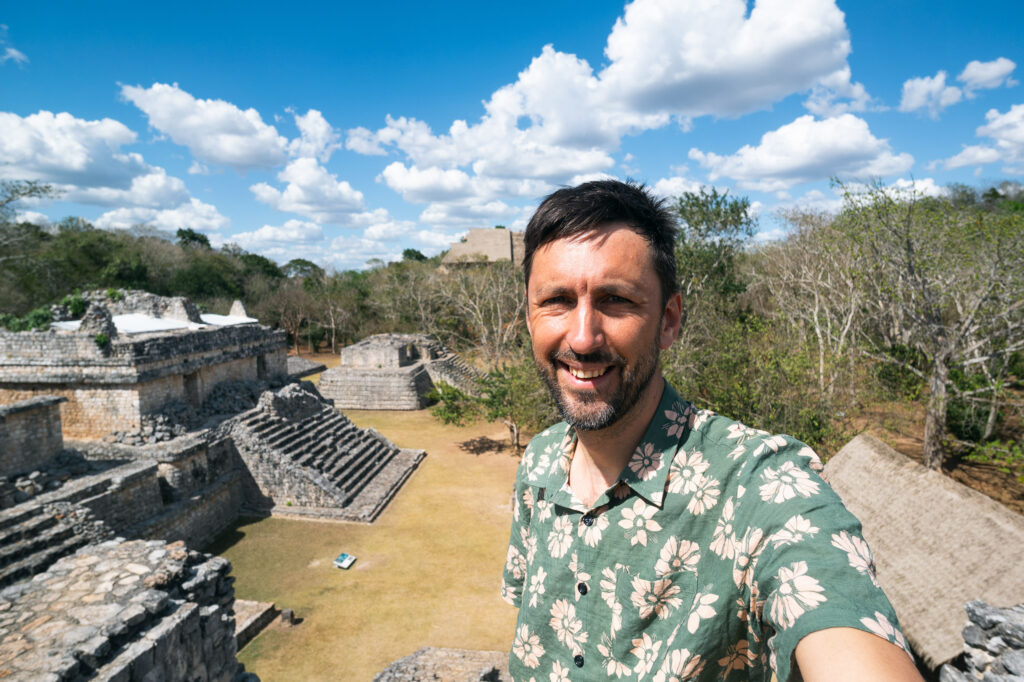
To Merida, via Valladolid: After a few days of activities in El Cuyo, we headed south, visiting the alternative Mayan ruins of Ek Balam (where you can still climb the pyramid) and the stunning, off the beaten path cenote known as Sac-Aua. From El Cuyo to Ek Balam takes about 2 hours, mostly through rural plains.
Since this was a family trip with our 4-year old daughter in tow, we wanted to keep the driving a bit manageable. For this reason we skipped Valladolid, but otherwise I would have added it in. Like Merida, it’s a major cultural city, and a great jumping-off point for Mayan ruins and cenotes. We chose to drive on to Merida, following the 180D toll road — taking another two hours or so.

Merida & around: This was our base for the middle portion of the trip. You can read more about this cultural and historical hub in my Merida travel guide.
This city has day trips in literally every direction, so it’s amazing to have your own vehicle here. You can drive the Ruta Puuc, a driving route via some of the region’s best archeological sites. We visited the ruins of Uxmal, which I would argue is just as impressive as Chichen Itza (maybe even more) with just under a tenth of its visitor numbers. The whole region around Merida is dotted with incredible cenotes, most of them much less on the radar than the cenotes near the Riviera Maya while being just as spectacular. Driving from Merida to Uxmal takes about an hour.

To Bacalar: After some days in Merida, we went down and across the peninsula to Bacalar in the south. This was the longest segment of our trip and frankly the dullest to drive. There is very little along this axis apart from a few agricultural towns. I tried my best to find interesting stops along the way, scanning for attractions on Google Maps or looking at travel itineraries, but there really isn’t anything to break up the journey.
The dull 5-hour drive is worth it however, as the lagoon-side town of Bacalar is a wonderful gem. It feels almost like you’re on the Caribbean coast here, having similarly glittering cyan waters, but far fewer crowds. You can read all about it in my Bacalar travel guide.
Return to Cancun: Rounding out the trip, we headed north back towards Cancun. We thought about staying in Tulum for a night or two, but it was badly affected by sargassum (seaweeds) at the time. We pushed on to Puerto Morelos, the seaside village we had already enjoyed earlier (it was another trip of about 4 hours).
It’s the perfect place from which to drive the ‘Ruta de los Cenotes’, a national road leading to countless limestone sinkholes, as well as a very cool reptile sanctuary where you can get up close to various crocodiles and snakes.
I was very pleased with this triangle-shaped route that offered lots of variety, with manageable driving times (up to ~ 4 hours at a time). Valladolid could have been an added stop, and I recommend this if you have the time available. If you’re feeling adventurous and up for the detour, you could consider driving to the ruins of Calakmul — another one of those remote spots best reached with your own transportation.
I hope this has given you some road trip ideas and prepared you for the practicalities involved. It’s a unique opportunity to have a truly freewheeling trip in a part of Mexico that is perfectly suited to self-driving. Just don’t say I didn’t warn you about those topes!