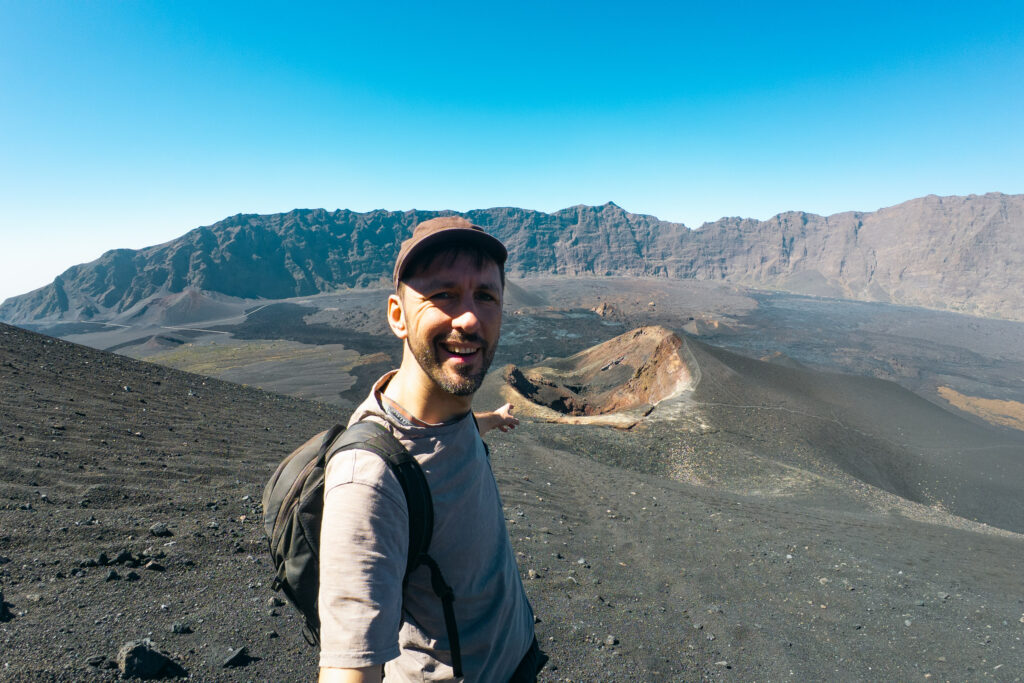
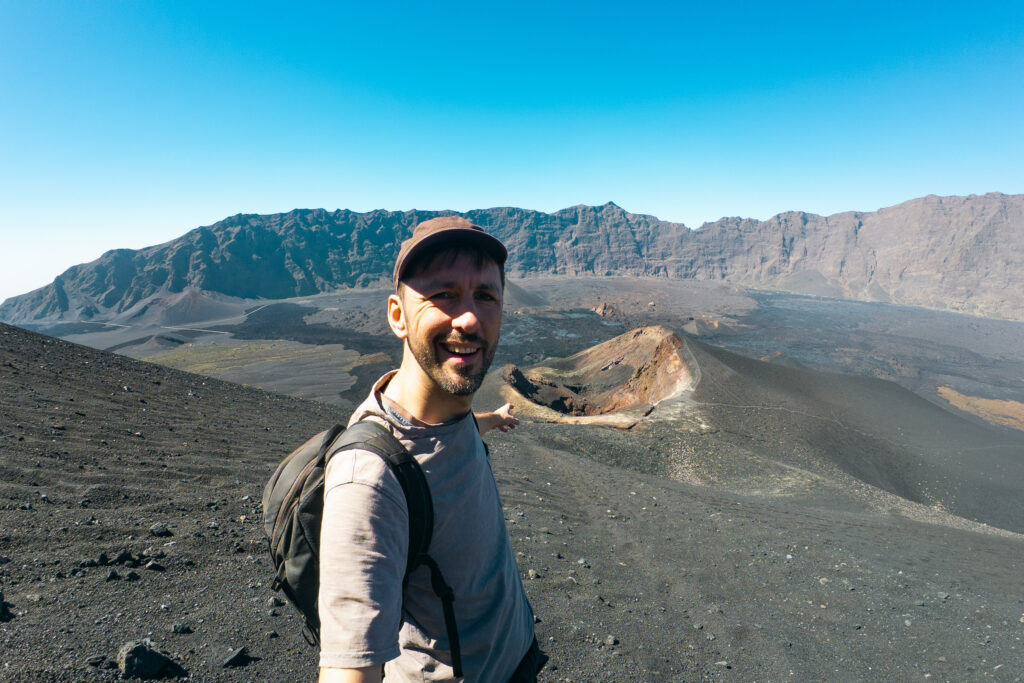
Ilha de Fogo means “Fire Island” in Portuguese, which you realize is a highly appropriate name as soon as you see the colossal caldera at its center, its volcanic peak still emitting fumes.
While currently dormant, it last erupted in 2014, enveloping the village of Chã das Caldeiras with massive floods of lava. Remarkably, this village has since been rebuilt — and despite the risk, people still live inside the caldera right beside the volcanic cone, kept here by the mineral-rich soils that support a variety of crops.
Climbing the volcano and, thrillingly, sliding back down through volcanic gravel, is easily one of the most exciting things I’ve done in Cape Verde — or anywhere for that matter. Here I’ll share everything you need to know about the island and all the practical steps for planning a side-trip to Fogo from Santiago Island.


How to get to Fogo
Since there is no international airport you can’t get to Fogo Island directly from abroad, but it’s not too difficult getting there from Santiago Island.
By ferry: Ferries go every day except on Sundays from Praia’s ferry terminal. The journey takes about 3.5 hours and is quite comfortable aboard the modern ship. While I love to watch the waves and have my head in the wind a bit on boat trips like these, unfortunately the ferries by CV Interilhas force you to sit inside the seating area behind the somewhat murky windows. No wandering is allowed anywhere else on board, though it’s nice and airconditioned. A one-way ticket costs about 44 EUR.
By plane: Domestic propeller planes go every day, including on Sundays. The trip from Praia International Airport takes only about 30 minutes. However, the flight costs about 75 EUR one-way—nearly double the ferry. The only airline servicing this route is Cabo Verde Airlines. They only allow 6KG of hand luggage on domestic flights, but even without including check-in luggage when booking my flight, I noticed that my ticket included up to 23KG of checked in luggage, so it wasn’t a problem even for my carry-on-only travel style.

Although the ferry takes longer, it’s much more cost-effective when you factor in your whole journey. Praia International Airport has no public transport connections at all and every taxi trip to or from there is charged at a regulated rate of at least 1500 CVE (or 2000 CVE at night). Getting to or from the ferry terminal is much cheaper, with the normal local taxi rates available as well as public aluguer minibuses going there.
Both ferries and flights have a dual-pricing system with higher prices for non-resident foreigners. I recommend the ferries if you’re on a budget, and planes if you wish to minimise your travel time.
São Filipe: your landing pad in Fogo
Arriving in São Filipe (population ~ 22000), I immediately felt welcomed with warm African vibes. From the bright street art to the colonial heritage architecture and from the lush purple bougainvilleas to the well-dressed women wearing goods on their head, São Filipe is a lively and colorful place — and it’s the obvious gateway into Fogo Island.


I should say there isn’t necessarily that much to do in São Filipe. Apart from surveying the pastel-colored 18th-century sobrados (houses) and browsing the municipal market, it mainly just serves as a pleasant base with plenty of accommodation and restaurants. You may find one or two nights in São Filipe sufficient — or maybe three nights at most if you’re doing a day trip to Mt. Fogo.
São Filipe has arguably the island’s widest range of accommodation available. Since I was trying to stay within a specific budget, I opted to stay at OpenSky Hotel, which offers affordable, comfortable, and clean rooms in an accessible location. The owner is very welcoming and speaks English fluently.
For something a little more upper-range, check out Casa Colonial Koenig, which is easily the most beautiful boutique hotel in town. Hotel Savana is another strong pick, located right on the flowery main square.


São Filipe is built on a cliff beside the ocean with views of the waves from many of its back streets and its main plaza. Two cobbled roads lead to the black sand beach below, which seemed conspicuously absent of people even on the weekend. I wondered why, until I saw hundreds of little critters jump up as I hiked along the shore. I’m guessing these were sandflies, offering a plausible explanation for why this beach is so ignored. (Strong currents may be another.) However, this buggy beach is still a very scenic place for a sunset walk.
While itself light on sights or activities, I did love the atmosphere in São Filipe, the cocktail bars (like Tropical Club and Zebra Corner), and the food options that are much more numerous than in Chã das Caldeiras. It’s among the prettiest towns I’ve been to in Cape Verde. To experience more of the island, you can catch onward travel to Chã das Caldeiras here, or depart on a coffee & wine tour of the island.
Because there aren’t too many things to do in São Filipe itself, it’s a good idea to take a tour all around the island’s coastal route to see more of Ilha de Fogo.
The tours include local touches that are usually difficult to experience on your own, such as stopping for a local wine tasting or visiting a farm to try a drink made of baobab fruit.
Chã das Caldeiras: the village inside the caldera
Staying in this remarkable village was easily the highlight of my stay in Fogo. While reached within about 90 minutes from São Filipe, it feels like a remote outpost among the seas of volcanic rocks and hardened lava flows. On one side, you see the beautifully symmetrical cone of Mt. Fogo — on the other, the magnificent caldera wall looming over the village like a giant.
In 2014 Chã das Caldeiras was almost completely wiped out by an eruption’s unstoppable lava flows (luckily with no casualties). Remarkably, many of the villagers chose to stay put, rebuilding the village from the ground up. Part of their motivation is the mineral-rich soils, which allow different crops to be grown here. It’s easily missed at first glance, but vines are planted throughout the valley, and Chã is the main place in Cape Verde where wine is produced.
The houses here are made of cinderblock and volcanic rocks, giving it a bit of a Moon Base feeling — or maybe I was faintly reminded of the Mongolian steppes due to the conical, almost yurt-like shapes of the stone roofs above some of the circular houses.
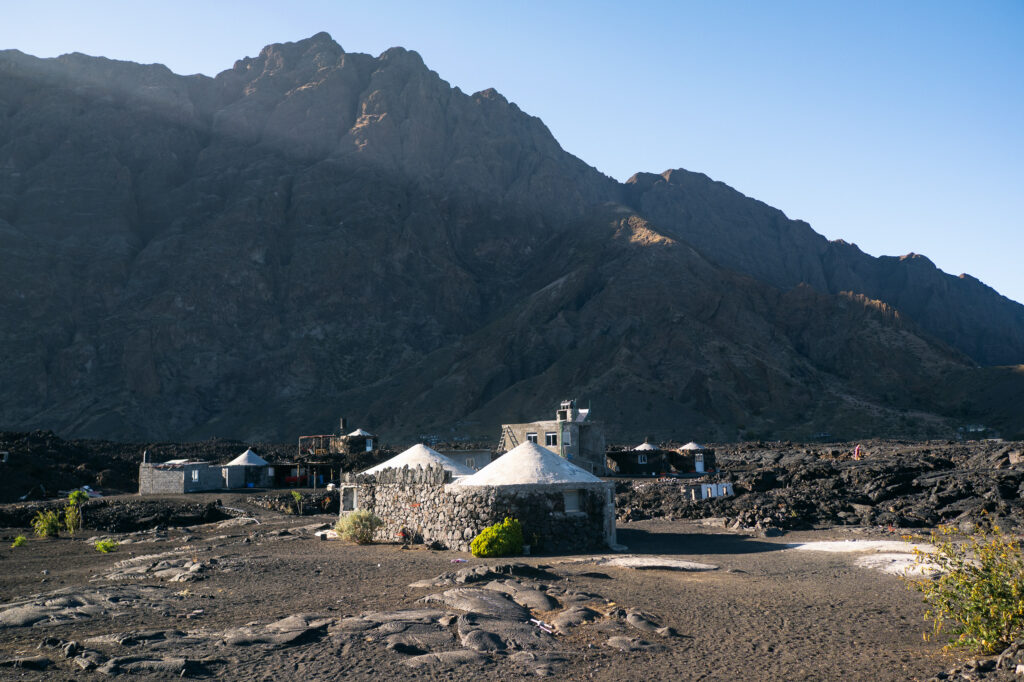


While basic, the village still feels reasonably developed, especially along the main road. You have a choice of 3 or 4 restaurants serving simple Cabo Verdean meals, though the two minimarkets have only a very bare selection of goods. It’s best to bring things from São Filipe, or to rely on your accommodation for drinks and food.
There are at least a dozen or so guesthouses and B&Bs to stay at here. My eyes were immediately drawn to Jose Doce guesthouse (also shown as Pensão Repouso on Booking.com), the only one to be built entirely out of volcanic rocks. Not only did Jose use the locally available materials to construct the walls, he also carved from it decorations and sculptures that give the place an arty feel.
The large windows in the dining area offered direct views of Mt. Fogo. Seeing the peak cast in an orange glow every night while sipping a cold beer was a great plus of staying in this place, even though it’s a 5-10 minute walk from the central road crossing where most of the restaurants are. The host is kind and welcoming and I highly recommend staying at his establishment. (He has big plans for a new common area and creating viewing platforms above every room.)


Although I love to recommend Jose Doce, there are other options in town. The highest-rated guesthouse that I could find was Casa Ze & Sonia. For something a bit more stylish, check out the B&B EcoFunco. Here every guest has their own little bungalow. These funco structures are traditional Cape Verdean circular houses.
Keep in mind that Chã das Caldeiras is a somewhat off-grid place, so no matter where you stay, you probably won’t have electricity during the day before the generators are switched on, and there may be limited hot water. This does add to the rustic charm. A cell tower on the hill next to the village does provide 24/7 phone and data connection, should you not want a full digital detox during the day.
How to get to Chã das Caldeiras: The main way is to get a shared minibus (aluguer) from São Filipe in the morning. One way it costs 900 CVE (this seemed about 300 CVE more than a similar trip would take on Santiago Island, so I’m not sure if this is some special tourist price). The aluguer leaves only when full and the journey will easily take 2 hours as it often stops to pick up or drop off passengers. I took an aluguer back which goes at 7 AM. Apart from the alugueres, the only way is to use a private taxi, which would cost at least about 60 EUR one-way.
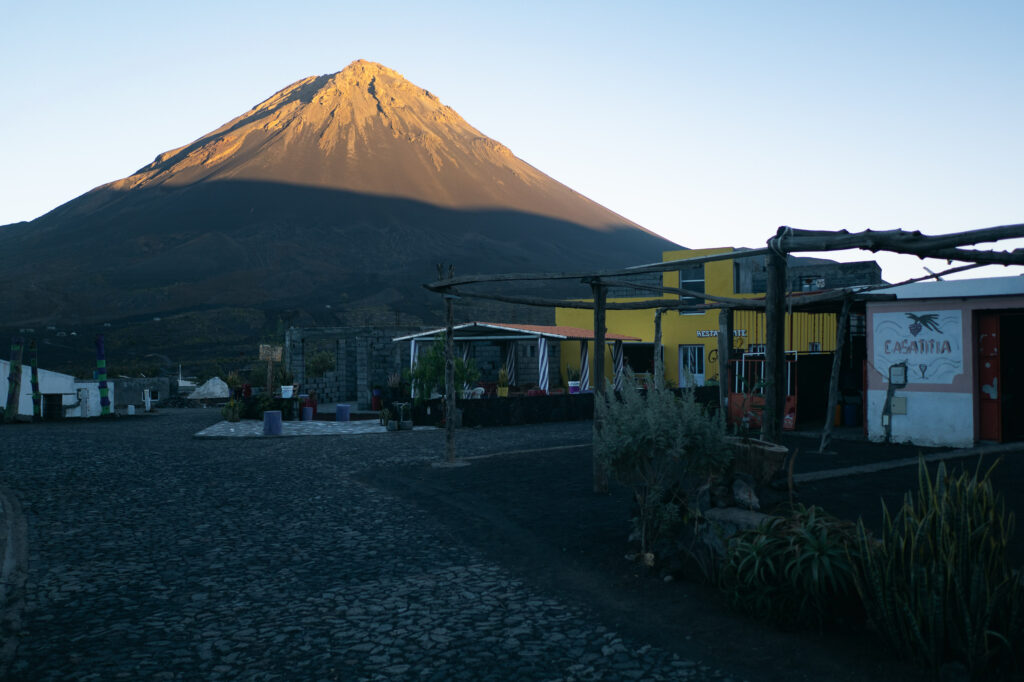
The hike up Mt. Fogo
A hike up and down the volcano takes at least about 5 to 6 hours and will reward you with otherworldly views throughout. While the trail is more or less indicated with occasional graffiti marking, it’s still mandatory to use a guide.
Even if it weren’t, I would advise hiring one anyway. Some parts of the trail are poorly marked, they don’t match apps like Alltrails or Maps.me / Organic Maps exactly, and the trailhead can be very hard to find in the dark if you want to have an early start. The guides also know exactly where it’s safe to slide your way down through the gravel if this is what you want to do. As an independent hiker, I must admit a guide has real value here.

Before coming to Fogo I wondered if I should pre-book a hiking guide. I shouldn’t have worried, as tourism in Chã das Caldeiras is entirely built around volcano hiking, so your local accommodation can always set you up with a trusted guide.
However, if you’re in Fogo on a brief visit (without staying overnight in Chã das Caldeiras), it makes a lot of sense to reserve a hike with transportation from São Filipe included. There is normally only one daily aluguer public transport connection between these places (and it’s slow, stopping everywhere) so a tour van is the practical way to do it all on the same day.

Yes, a local mountain guide is mandatory if you want to summit the volcanic cone.
If you’re staying in Chã das Caldeiras: You can simply contact your accommodation who can set you up with a guide. I stayed at Pensão Casa José Doce, a unique guesthouse with an arty vibe built entirely out of volcanic rocks. They quoted 6000 CVE (about 55 EUR) total for any party of 3 people or under. For larger groups, it becomes 2000 CVE (18 EUR) per person. If you’re a preplanner and want to nail things down, you can also book this hike on GetYourGuide, which is actually a little cheaper than the local in-person price.
If you’re only staying in São Filipe: Then you should definitely pre-book! You will be picked up at 6 AM in São Filipe, drive for about 2 hours, then start your hike. You will return on the same day, so this is a very time-efficient way to experience Mt. Fogo. The downside is the added cost: it’s 85 EUR per person to do all of this as a day trip from São Filipe. Check this tour and select “pickup in São Filipe” to confirm availability on your date. You won’t be in time for sunrise views of the caldera, but you also won’t need to stay overnight in Chã das Caldeiras.
The hike is a fine example of “early bird catches the worm”. If you start the summit late, you’ll be sweating your face off in the midday sun. Start in darkness, and you’ll not only be more comfortable but will also see the caldera in a stunning early morning orange glow.
I begrudgingly got up at 4:30 AM for breakfast, but it was 100% worth it — and my morning grumpiness rapidly melted away with excitement for the experience. We set off at 5 AM, hiking through the dark with the cone of Mt. Fogo silhouetted against a beautiful starry sky. An hour or so into our ascent, the sun’s first rays began poking over the horizon, revealing the caldera and a sea of clouds over the ocean.
Soon the sun rises far enough for Mt. Fogo to cast an enormous shadow over the valley, a stark contrast and a dramatic view that makes you wonderfully aware of being on a planet.


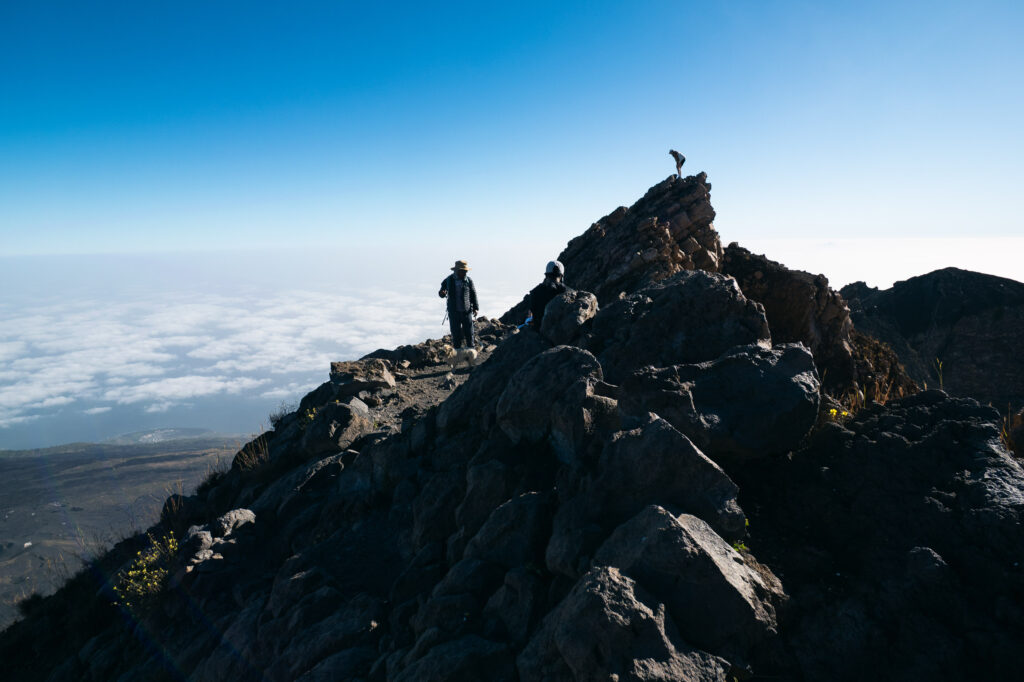
By the time I reached the top, the mountain was already bathed in full light, and it was warm enough to cast off a few layers. There is a viewing point about 20 meters below the actual peak from where you can peek inside the crater, where fumes will be billowing up from the rocks and where the smell of sulphur hangs in the air.
From this point, you have two options. You can either hike back the same way you came, or you can switch over to the peak’s other side (the one facing Chã das Caldeiras) and go down almost entirely off trail here.
This side is mostly covered by layers of loose volcanic gravel, which you can actually descend rapidly by sliding through it. I was gleeful to discover that stepping into the lightweight rocks is strangely a bit like stepping into a thick layer of snow, often getting yourself ankle-deep in grit. There was something quite surreal about shifting your way through the landscape, your legs melting into a river of rocks.
I found it not just exhilarating, but also a very efficient way to get down that is a lot easier on the knees than a regular descent. It’s a bit like volcano-boarding (of the sort you can do in Nicaragua), just doing it step-by-step and without a board. You can do it at your own pace and it isn’t too strenuous, but it is still mildly adventurous, so you may still opt to go back down the normal path if you prefer.
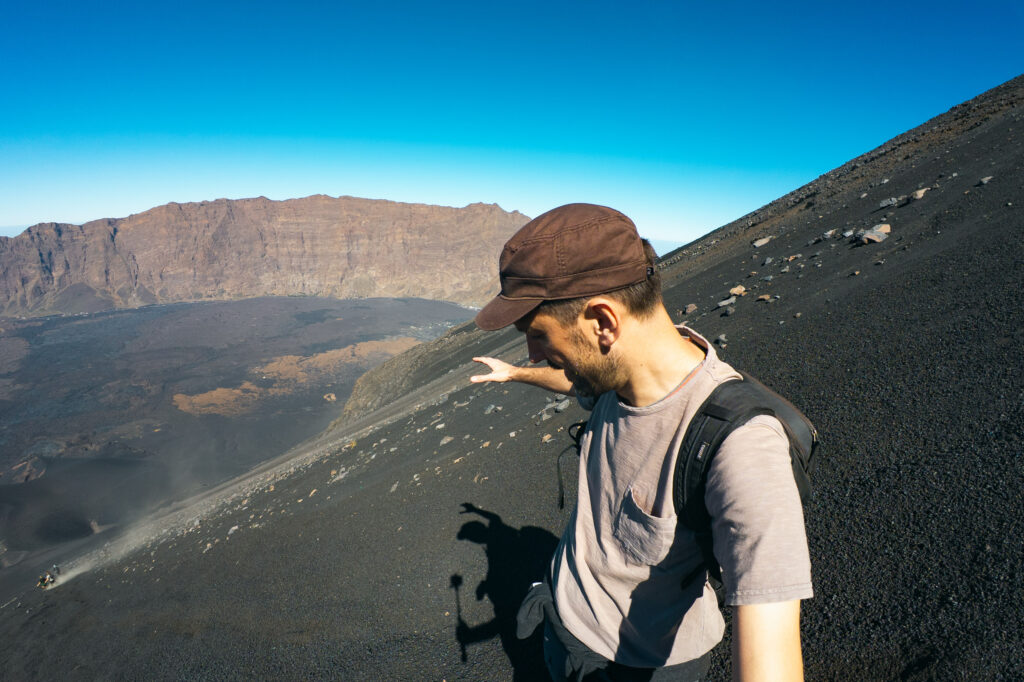


Going back through the gravel has the advantage of letting you circle back via Pico Pequeno, the smaller crater near the base, offering some stark landscapes that make you feel like you’re on some mysterious planet.
One thing to know is that your shoes will definitely fill up with small rocks and persistent fine volcanic dust. Despite thoroughly dusting off my hiking shoes following the hike, I still kept having blackened socks and feet for several days whenever I wore them again.
I would say… pretty difficult — as volcano hikes tend to be. Being inherently steep and having fewer switchbacks than your typical mountain trail, you will likely be out of breath often. I would advise this hike only if you have a good fitness level and don’t suffer from any physical limitations.
That said, it’s doable. You just need to plow ahead for about 2.5 to 3 hours to get to the top. After this, the hiking is still strenuous on the legs, but less heavy on the cardio. I must admit that by the end of the full 6–7 hours, my legs and feet were pretty battered, and I needed a full day for recovery.
If you’re not sure the hike is for you, it’s still worth coming to Chã das Caldeiras. From the village you can hike to Pico Pequeno and also visit a lava cave along the way. (On some maps, it’s called Pico do Inferno.) Some parts of the trail are somewhat elevated, giving you a better view of the caldera, but without the intense ascent. As a bonus, this alternative hike is also easy to do without a guide, especially if you have the trail available on a map app.
Where next?
The hiking at Mt. Fogo was definitely the poster reason for me coming to this island and ended up being an extremely memorable experience.
While the volcanic peak is for sure the main point of interest, if you want to see more of Fogo Island, you can still use São Filipe as a base for further excursions. Just expect the sights to be at a much smaller scale: stops include a small pool in the rocks at Ponta da Salina, an ancient baobab tree, or a local wine tasting in a village.
Like a wine pairing with a meal, the hiking-focusing Ilha do Fogo pairs very well with neighboring Santiago Island, which is larger and offers a greater variety of activities. Don’t miss my guide to Santiago Island in which I share the best hikes and the most interesting cultural and historical aspects on this island.