Even though Cape Verde is often cast as ‘Africa lite’ — due to its high level of development, safety, and ease of travel — there are still some important things to know before planning a trip here.
Having visited four of the islands across two trips, let me share some tips that will point you in the right direction. I have specific guides to each of the islands with the best things to do, but here I’ll get into the practical aspects of planning an active Cape Verde trip.


I should mention that I’m a big fan of hiking, which makes me an especially big fan of Cape Verde with its many volcanic calderas and dramatically jagged peaks. But even if you’re here for a culture or perhaps just relaxing at a less commercial beach, there is plenty to unpack.
Cabe Verde is known for its volcanic landscapes, warm tropical climate, Portuguese colonial heritage, unique musical forms (including morna and sodade) and delicious hearty cuisine. It’s Africa’s most westerly point and thanks to being in the middle of the Atlantic, it’s in a perfect location for whale, dolphin, and sea turtle spotting.
If it’s your first time visiting this archipelago, then read on…
The two kinds of tourism in Cape Verde
Firstly, Cape Verde has a whopping 10 islands to choose from. This may seem overwhelming, but they can really be boiled down to 2 specific categories.
There’s Sal and Boa Vista — and then there’s everywhere else.
These two islands specialize in all-inclusive resorts catering almost exclusively to fly-and-flop holidays. If you book a trip to Cape Verde with a holiday agency like TUI, Sal is almost certainly where you will end up.

For culture- or nature-seekers like me, there is little to experience on this side of the archipelago. Sal is one of the least populated islands and is almost entirely desert. The resorts here are of the kind that could really be anywhere (well, anywhere with good weather and a sandy coastline). Authenticity can be hard to find; even the food at the resorts gets shipped in from Europe.
Around 90% of Cape Verde’s tourism revenues come from Sal, but here I will focus on the ‘other 10%’ — the islands that are perfect for independent travel.
Some of these islands specialize in a certain experience (for instance, Santo Antão is great for hiking while São Vicente is great for its music). However, they all share in common that they lack the commercial resorts of Sal and Boa Vista and lend themselves perfectly to self-guided trips.

What to expect from Cape Verde
Cape Verde is not one of those famous destinations that everyone already has some frame of reference for. It’s quite under-the-radar and many people would probably struggle to point its location on a map. So, let me first offer a few observations that may help you know what to expect.
1. Cape Verde looks better in person
It’s maybe an odd thing to point out, but Cape Verde was much more eye-catching to me than I had expected when initially researching it online.
While I’d heard good things about Cape Verde, before my first visit I still had some lingering doubts about the kind of landscapes I could expect to see. This probably had to do with the type of visuals I mostly saw online.
With Cape Verde still being somewhat niche (outside of the resorts), the photography out there is not always that slick or polished. Photos are often murky and perhaps taken by local tour guides using old phones. This combined with the dryness of some of the islands at certain times of year can make it look less appealing.
However, Cape Verde really hits different when you see it in person.
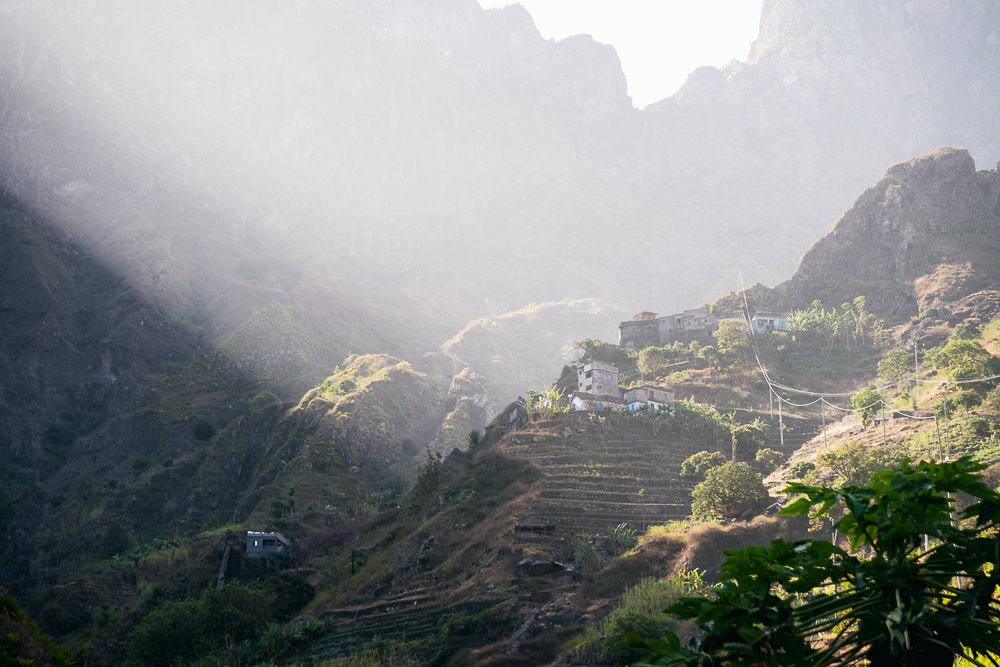

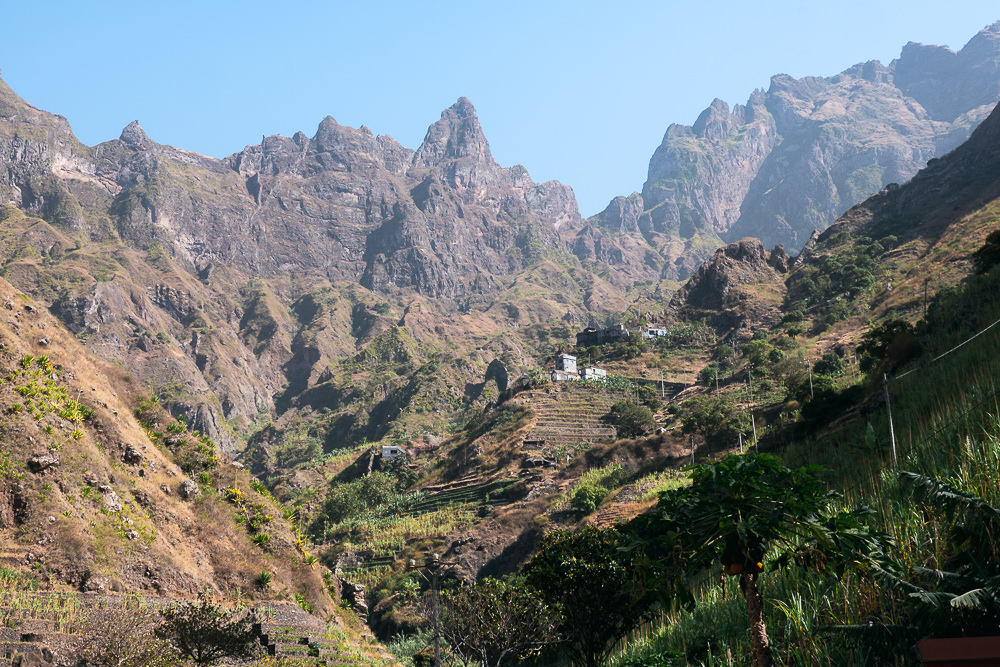
Between the cinderblock buildings in the villages you’ll also see bright street art and colorfully painted walls. The rocky, desert-like landscapes are so much more captivating when you are standing within them. And on the greener islands, you can find yourself amid the banana and mango trees, enjoying a more tropical island vibe.
Each island does have their own distinct color palette. Some, like Santo Antão, are more often green and lush. Others like São Vicente or Fogo look mostly like a Martian surface — and are striking in a different way.
2. The people are super friendly
It may seem like a cliche, but it’s genuinely striking to me how friendly, open, and relaxed the people are in Cape Verde. There’s a major ‘no worries’ energy here that makes interactions very easygoing.
Of course, you are still a tourist and people will sometimes try to sell you things. Linger on a main square for a while and some tour guide might try to entice you into joining an island tour. However, typically they will just genuinely show you what’s available and leave you alone if you’re not interested. It’s not part of the culture to be overly pushy or aggressive.
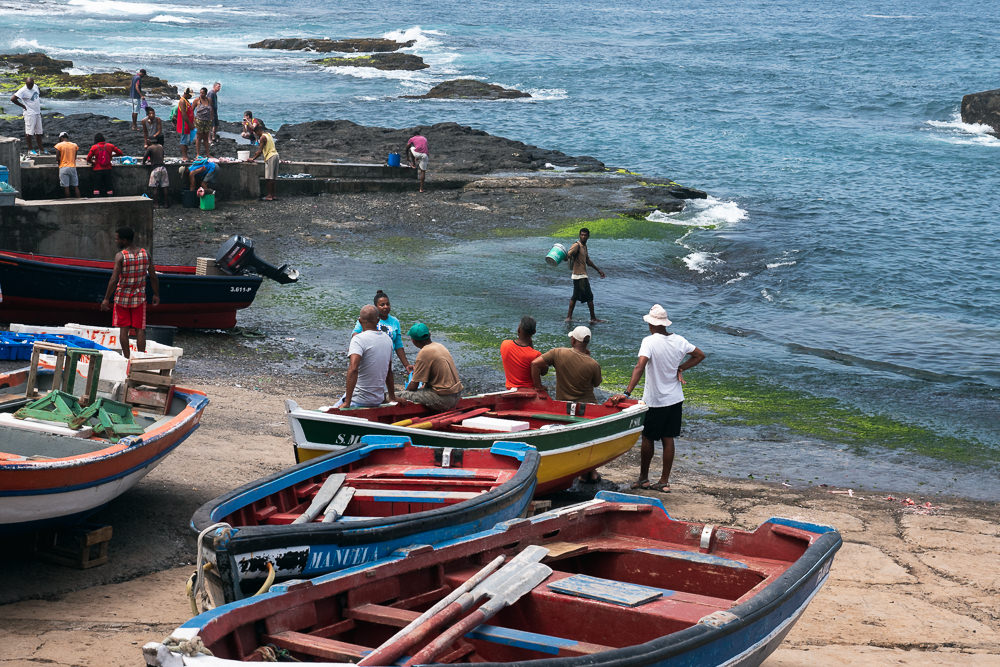
In this sense Cape Verde feels the opposite of, say, nearby Morocco, where you are constantly besieged by scammers or sellers. In Cape Verde you can casually browse a store or souvenir shop without immediately triggering a salesperson into feverish pitches. Scams seem to be pretty rare; even taxi drivers were honest in my experience.
Cape Verde also has fairly high safety levels, making it an easy introduction to Africa. While I’ve heard of some issues in the big cities (e.g. Praia and Mindelo), outside of a few specific areas the vibe feels peaceful and stress-free.
The level of development, while below that of Europe, is very high compared to most (West) African countries, making it overall an easy place to travel.
3. It’s affordable… though not ‘cheap’
And that brings me to my next point. Because of its level of development, don’t expect to find rock-bottom prices in Cape Verde.
It’s not an ultimate bargain destination like, say, certain backpacker favorites in Asia. I would personally characterize it as ‘medium budget’, with some aspects like local transport often being very affordable, but tourism-specific prices being closer to the level of Portugal or eastern Europe.
Here are some rough indications to give you some idea. 100 escudos is about $1.10 USD or €0.90.
| Simple meal in a local restaurant without drinks | ~ 600 escudos |
| Meal in a tourist-focused restaurant without drinks | 900 – 1100 escudos |
| Basic room in guesthouse or pensão | Starting at ~ 2500 – 3000 escudos per night |
| Hostel dorm-bed accommodation | ~ 1500 escudos per night in dorm |
| Fancier guesthouse (e.g. beautiful decoration, Airbnb-style) | 5000 escudos per night and up |
I’ve mostly travelled around Cape Verde in a style somewhere between backpacker and mid-budget. On average I’ve paid about 30 EUR a night for basic rooms. I usually get lunch at bakeries or simple cafes and have one restaurant meal at night. A budget of about 50-60 EUR per day can suffice for this travel style.
Transportation between towns and cities can be very inexpensive if you take shared minivans called alugueres. A 2-hour trip from Praia to Tarrafal on Santiago by aluguer costs about 600 CVE (approx 5.5 eur).
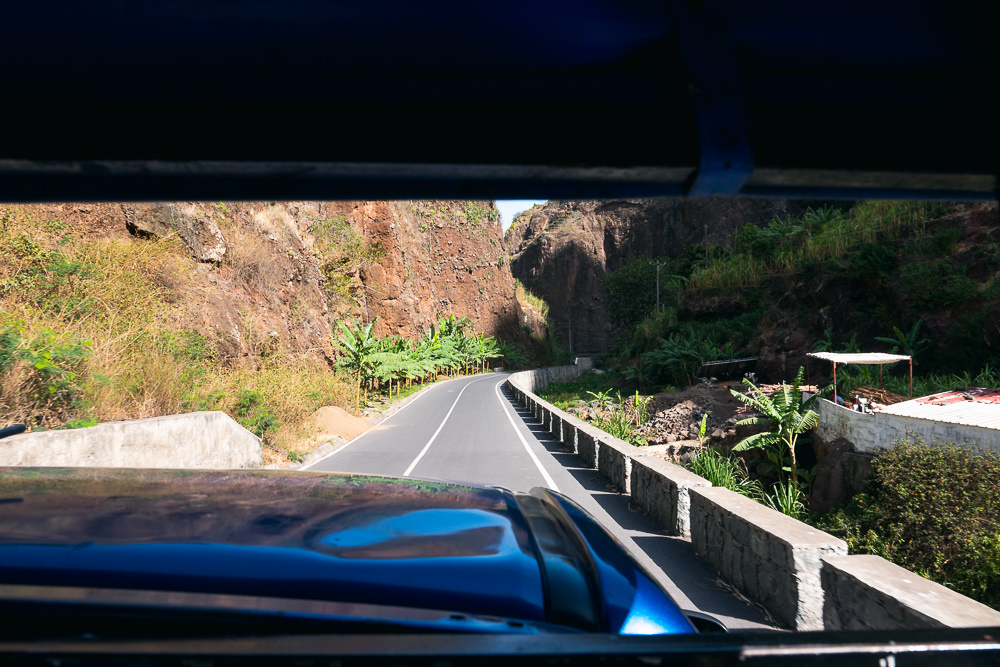
While local transport costs are low, ferries and flights have special higher rates just for tourists, meaning the costs for island-hopping can quickly add up.
Guided tours can be more or less European in price too. For instance, a guided hike might cost 40-50 EUR per person, and a full day island tour by private minivan can cost anywhere between 50 and 100 EUR per person.
Cape Verdeans know well what to charge and what tourists are willing to pay. If you’re a budget traveller, you can make more use of the local economy — and I’ll share some cost-saving tips later.

4. The language barrier is surprisingly manageable
A final point that might stop you is the local language. Cape Verde was once a Portuguese colony, which means that Portuguese is still the official formal language. Since this is not commonly spoken in Europe outside of Portugal (and is a lot more different from Spanish than many assume), this might make it difficult to communicate. Or so you’d think.
Actually, in part thanks to its worldwide diaspora, Cape Verdeans tend to be multi-lingual and may surprise you by speaking English, French, or Spanish. So whatever languages you can bring to the table, they may come in useful in Cape Verde.

French and English are widely taught in schools, and since a lot of Cape Verdeans have worked abroad, they may be able to muster some other languages as well. I picked up some local hitchhikers while driving around Santo Antão and one of whom switched to fluent Dutch as soon as he realized I was from The Netherlands. (There is a big Cape Verdean diaspora in Rotterdam.)
The most common language is Portuguese, as well as the local language known as Kriol which mixes Portuguese with African influences. I’m only a basic Portuguese speaker, so this creole is difficult for me to understand, but I was still able to pick out some keywords. People living in small villages might only talk to you in Kriol, while more affluent people will generally know Portuguese and possibly other languages as well.
Overall, Cape Verde is more raw and authentic than other Macronesian islands like the Canaries or Madeira, but travel here is also easier than in many countries in Africa.
I hope this gives you a better picture of what to expect. For a little more inspiration, you can check my 7 reasons why you should visit Cape Verde.
Where to go: 2 ideal itineraries
Ready to start researching a trip? Then let me tell you about two combinations of islands that I think work especially well together. If you want to dive into the culture and nature then these are the obvious starting points to consider.
You can hit up two islands for a well-paced 1-week to 10-day trip, or combine these two itineraries to include all four for a longer island-hopping adventure.
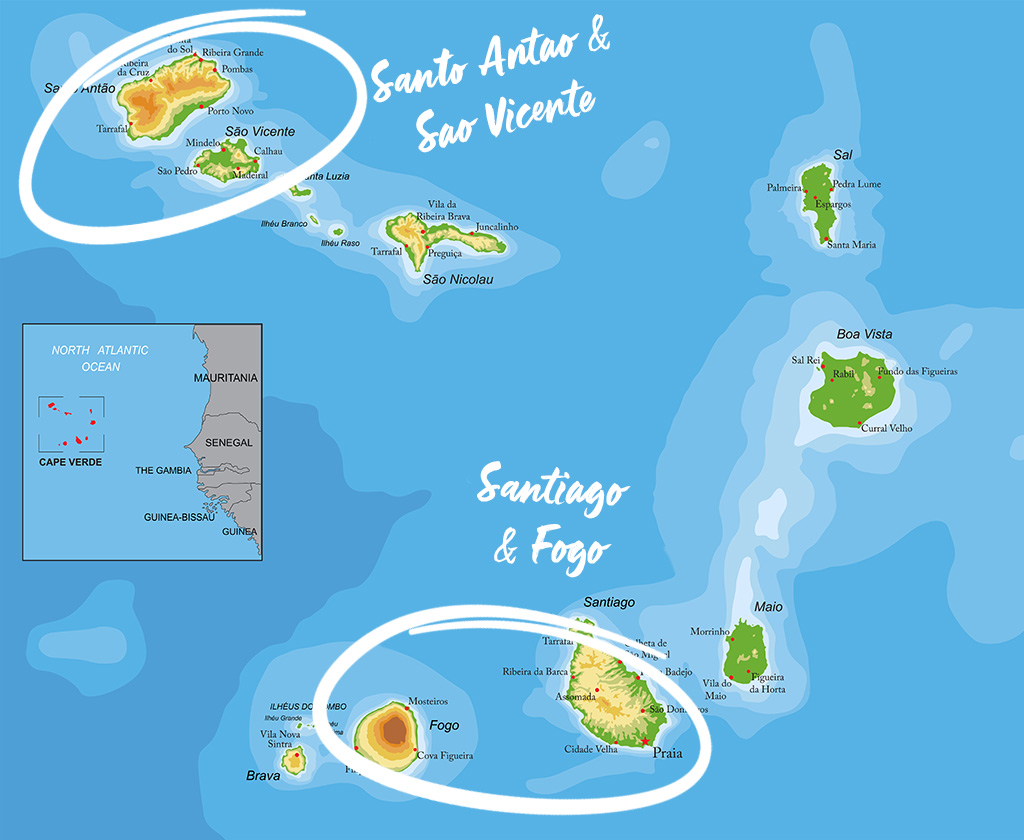
Itinerary 1: São Vicente + Santo Antão
Santo Antão is known as the best island for hiking and for this reason it is by far my favorite. The variety of landscapes and trails on Santo Antão are phenomenal. I recommend you read my guide to Santo Antão to get a sense of why I love it so much.
You can spend 5 to 7 days on Santo Antão to explore it properly and so that you have enough time for at least 3 or 4 of the top hikes. I recommend staying somewhere on the greener north coast. You can also dedicate some nights to staying in the coastal village of Tarrafal de Monte Trigo in the remote west, which has a wonderful end-of-the-world feel and has various water activities on offer.
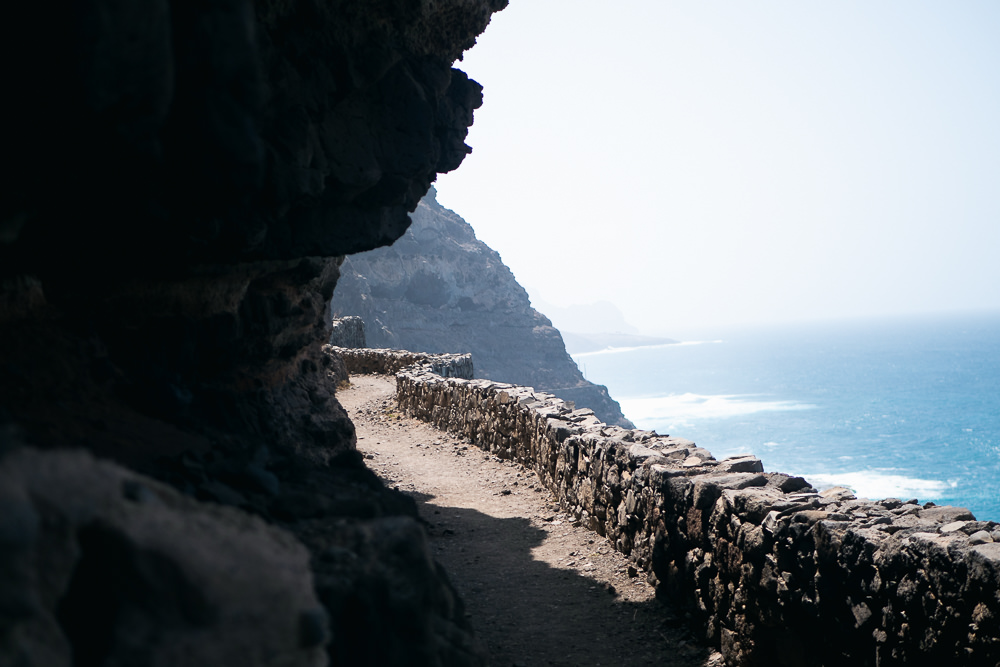


Santo Antão does not (yet) have an airport, so you have to fly into São Vicente first and then take the 60-minute ferry across. It’s worth spending a couple of days in São Vicente’s capital, Mindelo, which is known for its thriving music culture. São Vicente island as a whole is very rugged and barren with fewer things to do, but the landscapes are quite dramatic and worth seeing. Just on its own it doesn’t offer enough, but as a bonus to Santo Antão it works really well.
In my opinion, these islands offer the perfect combination of culture and nature. The only downside is that there are fewer flights from abroad to Mindelo, so it’s a bit less easily accessible than the two islands I’ll discuss next.
Itinerary 2: Santiago + Fogo
This brings me to the island Santiago, home to Cape Verde’s capital called Praia (literally meaning “beach” in Portuguese). There are plenty of direct flights here, including by Easyjet, which started flying here in 2026. This makes it a great starting point for a first-time Cape Verde trip.
To be honest, I find Praia not too terribly interesting. It’s mostly an administrative capital with that not much to see for tourists. It’s okay for a layover, but I prefer the more colorful and unpredictable towns and villages elsewhere.
The north of Santiago is the best part in my opinion and it’s highly worth making the 2 hour trip to the beach town of Tarrafal. It’s a chill place with a small yellow-sand beach in a protected bay and a welcoming assortment of restaurants, cafes, and local accommodations.
It’s ideally situated for both relaxation and active exploration. From Tarrafal, you can reach the most notable hiking trails within just a 20 minute drive. The hikes in the Serra Malagueta, passing by little hamlets in a lush green valley, remind me almost of some of the standout hikes in Santo Antão. It’s not quite on the same level but pretty close, while being much more easily accessible with Praia being the nearby transport hub.


From Santiago it’s just a 30-minute flight or 3.5-hour ferry trip to Ilha de Fogo, literally meaning “Fire Island”. Why it’s called that way becomes quickly obvious as you see the enormous volcanic caldera at its center. Hiking up the epic dormant volcano is a fierce but rewarding climb. Optionally you can slide your way back down through the volcanic gravel, a bit like volcano boarding but without a board. It’s definitely one of the most interesting experiences I’ve had in Cape Verde.
I recommend this pairing of islands for the easy access from Cape Verde’s second-biggest airport (after Sal). It offers a varied mix of activities — from epic hikes to local markets, and from beach relaxation to history museums.

Besides these islands, São Nicolau, Maio, and Brava offer more remote, off-the-beaten path options. They each are home to just 1 to 3% of Cape Verde’s population. I hope to visit some of them in the future, though I suggest one of the above itineraries for a practical first-time Cape Verde trip.
Getting to Cape Verde
Flying to Cape Verde has gotten a little easier in recent years as more carriers are adding it to their network. Sal is usually the easiest and cheapest to fly into thanks to the resorts, followed by the capital Praia, and Mindelo a distant third. These are the three airport names you’ll want to drop into your favorite flight search engine.
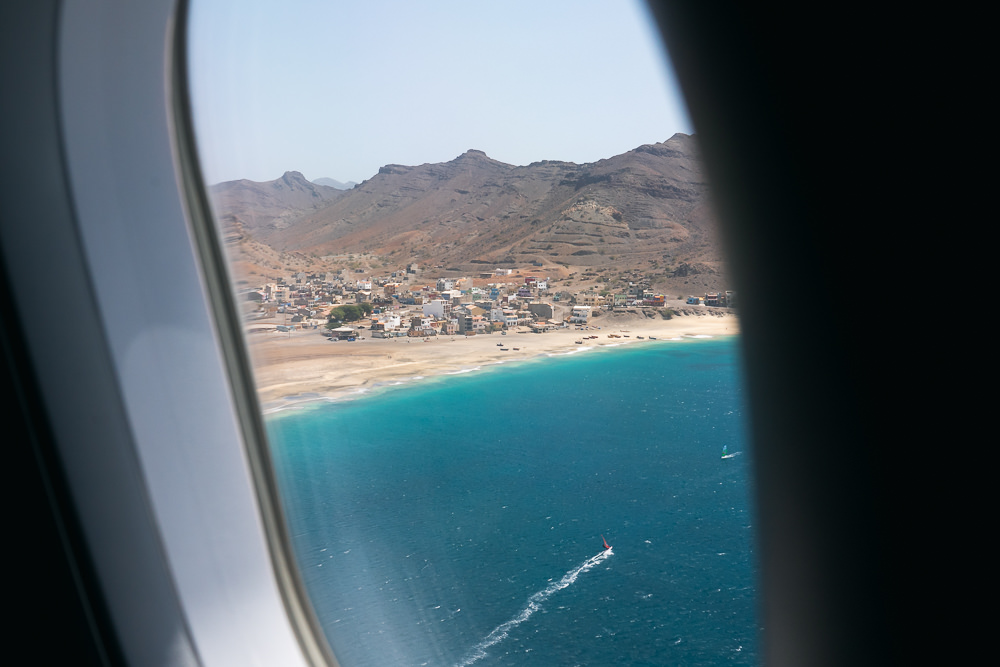
Cabo Verde Airlines and TAP Portugal provide most of the connections. They can be OK but I would actually go with one of the budget carriers if the option is available.
Cabo Verde Airlines is quite a basic airline and I would recommend them mainly for domestic island hopping, where they’re the only choice. Their website once took my money but never sent me any booking confirmation, and it took a lengthy customer service ordeal to get fixed. To be fair, my flights with them have been fine.
The less said about TAP Portugal the better though — it’s not a great airline. I say this as someone who lives in Portugal and has to live with TAP Portugal. I try to avoid them if I can.
If you can fly in with Easyjet on one of its new routes, that would actually be my recommendation. TUI Flights Netherlands and Transavia have also added flights to Cape Verde, connecting to cities like Amsterdam, Paris, Marseille and Lyon.
Many nationalities can enter Cape Verde with a visa on arrival. All you have to do is pre-register here up to 5 days before your trip.
When you pay the €31 security fee during registration, all you have to do on arrival is go to the electronic gates and enter by scanning your passport.
How to travel between the islands
Cape Verde’s island groups are quite spread out, so if you truly want to island-hop around it can cost you a fair bit of time and money.
That’s why I suggested earlier to hit up two neighboring islands, so that you have short plane or ferry connections available. But if you want to hop around more, it can be conveniently done as long as you budget for the internal flights (some islands are not connected by ferry).
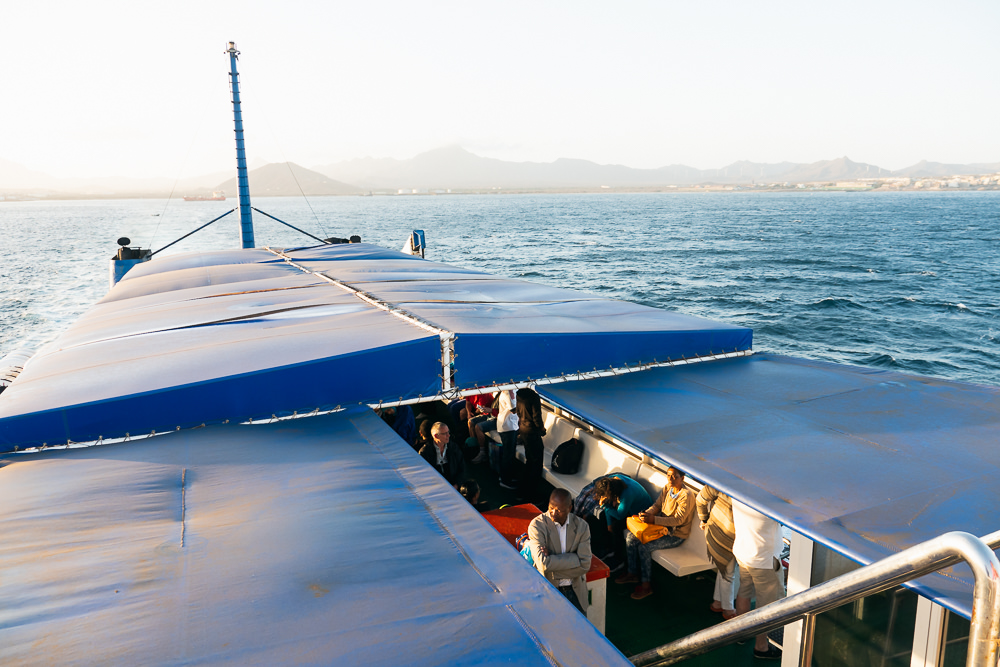
There is dual pricing for all the inter-island transportation, so as a foreign tourist you will be paying more than locals. There are pros and cons to both transport types.
By plane: There is only one company offering domestic flights between islands, which is Cabo Verde Airlines. (Binter Air stopped operating.) The flights are OK but they are a tad pricey. A quick 30-min flight between Fogo and Santiago cost me 75 EUR, about half the price of a single ticket from Portugal to Cape Verde, which is a 4 hour journey. Most airports don’t have any public transport, so include budget for taxi rides. At Praia airport it will be at least 15 EUR for the short drive into the city. This means that one island hop by air can easily end up costing 100-150 EUR per person total.
By ferry: CV Interilhas has the monopoly on ferries. They’re mostly modern ships, easily bookable online, and pretty efficient. You have to stay inside the whole way on the ferries; sadly you can’t catch some wind in your face or watch the waves from the deck, but it’s a good way to get around.
It’s slower than flying but it’s also a little cheaper; for reference, between Fogo and Santiago I paid about 44 EUR. An added cost benefit is that in the ports you can easily find cheap local taxis and minibuses without the high regulated fees for the taxis at the airports.
Budget travel tips
I think it’s easiest to explore Cape Verde on at least a medium budget, so you can enjoy more restaurant meals and don’t have to stress too much about the cost of taxis or guides. However, if you are on a limited budget, it can still be done.
Here are a few tips for keeping costs to a minimum:
- Look for local hole-in-the-wall places where you can get some roast chicken or grilled fish. This may cost about 500 escudos per meal, less than half what you’ll see listed in the typical restaurant menus aimed at tourists.
- Buy bread and fruit at the markets. You can pick up some delicious mangos or bananas for very little money.
- There aren’t that many backpacker hostels in Cape Verde, but there are several in Santiago, making this the easiest island for finding dorm accommodation.
- Take ferries instead of flights. The ferries cost less and you also avoid the expensive taxi rides from the airports.
- Use card payments whenever possible using a no- or low-fee card such as Revolut or Wise. While you still need cash for a lot of transactions, it’s good to avoid cash if you can, simply because the ATMs charge quite high fees.
- When booking accommodation Booking.com or Hostelworld you can also opt for places that let you pay via the platforms to further avoid fees. Unfortunately, most budget options handle the payment in person only.

Solo travel in Cape Verde
If you’re used to backpacker-style travel, then hostels can certainly help you meet other travelers. There aren’t that many hostels on Cape Verde but the few that exist can introduce you to other people more easily, if that is something you seek as a solo traveller.
For example, there is Simabo’s Backpackers in Mindelo, a cosy hostel which helps fund a nearby animal rescue center. Meeting Point Hostel has multiple locations in Santiago. The one island that is still really missing a hostel is Santo Antão, though I’ve heard that one may open there soon.
Cape Verde is not such a well-known backpacking destination (solo or otherwise), so you may not be able to socialize with other travellers easily all the time. If you are okay with doing some things alone or engaging with the local culture, you can have a great solo trip.
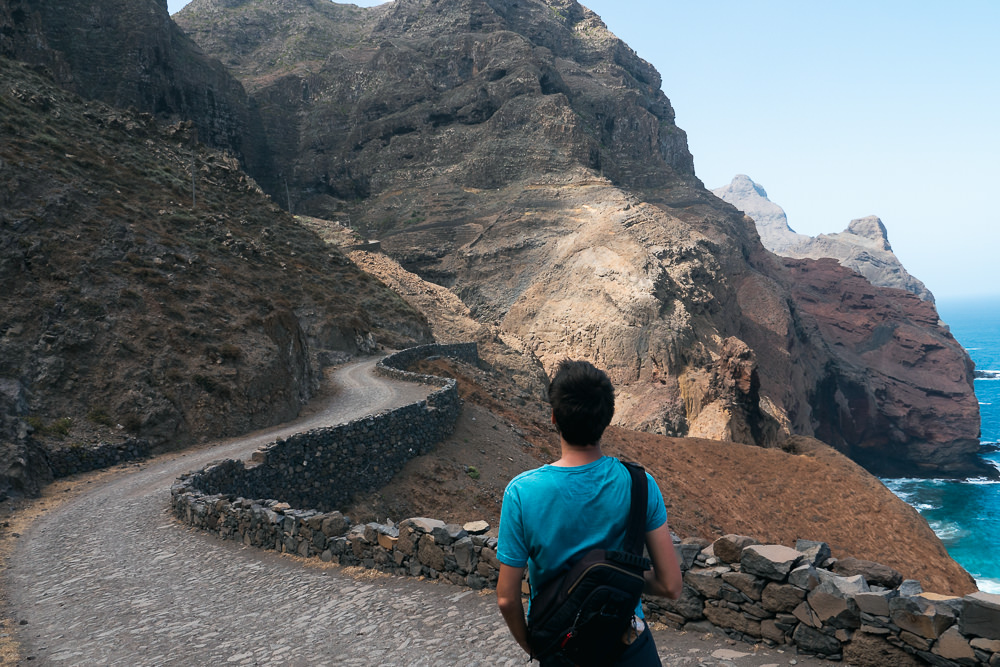
I’ve done both of my trips alone, including a lot of solo hiking on Santo Antão and on Santiago. (Only to hike Mt. Fogo I did so with a qualified guide, which is mandatory there.)
The main hiking routes are fairly obvious, especially if you keep maps with you in an app like Alltrails or Organic Maps. There are often villages along the way where you can grab lunch or ask for directions if needed. My specific island guides have more details on this.

Best time to visit
The best time to visit Cape Verde is generally considered from November to April. It’s dry and sunny during this time, making it a perfect winter escape from Europe or North America.
Both of my trips were in February, when you can expect air temperatures mostly in the 25 to 30 Celsius range, but it depended on the location. Coastal towns can be pretty breezy or some mountain towns can be a bit chilly, so pack your sunblock but don’t forget a jumper either.
Cape Verde is a tropical destination with a rainy season from July to October. That doesn’t mean it rains all the time — the islands actually get very little rain overall, and even in rainy season it comes down in short intense bursts.

It seems that the summer would be perfect for a beach trip since water temperatures are higher, but this is actually the low season for Cape Verde. One hostel owner even told me they close completely from June until August because there are just too few customers. Europeans generally know Cape Verde as a winter escape only, and during summer there are too many other destinations vying for their attention.
I’ve considered coming back to Cape Verde at the end of rainy season (such as in October), when the landscapes are greenest and the water temperatures are still at their highest.
Ready to dive in further? Then don’t miss my complete guides to Santiago Island, Fogo Island, Santo Antao Island, and Sao Vicente Island.