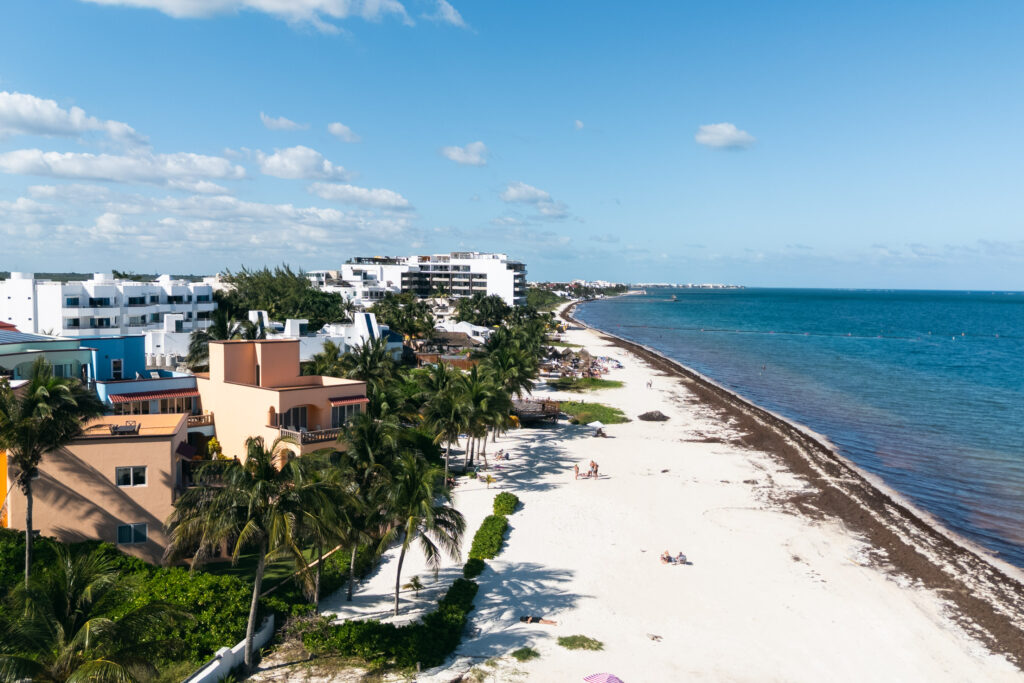
Laidback, bite-size and reassuringly low-rise, Puerto Morelos stands out as an odd duckling among the more commercial developments along the Riviera Maya. I highly enjoyed spending some easy days here, bookending my road trip through the Yucatan in Puerto Morelos.
Located about midway between the mega resorts of Cancun and Playa del Carmen’s thumping nightlife — each half an hour’s drive away north or south — Puerto Morelos is a little island of tranquility. The streets have kept their local texture, most tourism businesses are smaller-scale, and the pace is unhurried.

For sure, it’s not buzzing like Playa nor as trendy as Tulum, but if you’re just looking for some lazy days by the coast without any fuss, it’s the perfect spot. Exciting activities aren’t far away either; it’s just a 15-min boat ride to the world’s second largest barrier reef, and it’s right beside the La Ruta de los Cenotes leading to some of the region’s most impressive natural sinkholes.
If you like to take it slow you could easily spend a whole holiday here, though for me it was the perfect staging point for a wider Yucatán trip — with Cancún airport being just 20 minutes away. The town let me settle in and, at the end, happily wind down before my long flight home.
Below, I’ll share my impressions along with accommodation tips and a few activities I haven’t seen covered anywhere else.
What to expect
Some descriptions I’d read painted a rose-tinted picture of a sleepy local fishing village ignored by tourists, but that isn’t really accurate.
We’re smack in the middle of Mexico’s tourism epicenter here after all. Puerto Morelos is unavoidably centered around tourism with many hotels, several beach clubs, a souvenir market, and one or two resorts on its fringes. Waiters are more likely to speak English here than in inland Yucatan. If you order an Americano, it will probably be served in a comically huge soup-size cup the way Americans prefer (sorry, European here!).
While set up for tourists, it does so in a lowkey way that as an independent traveller I much appreciate. Most hotels are boutiques, cute shops sell genuine local handicraft, and cosy cafes and restaurants make you feel right at home. Prices are a bit higher than in, say, Merida or Valladolid, but very reasonable compared to Tulum or Cancun.

Much of the town feels residential with plenty of local life around — a mix of Mexican residents and a community of North American and European emigrants as well.
It’s useful to know that Puerto Morelos is split in two: there is a larger inland area and a smaller beachside strip, separated by 2km (or 1.5 miles) of mangroves. As a visitor you’ll surely end up by the beach, which is clearly the ideal area to stay. There are pharmacies, several ATMs, and one supermarket on this side, but for more amenities you may wish to make a trip inland.


Finally, I can say Puerto Morelos is very family-friendly, having visited with our 4-year old daughter in tow. There is a lovely playground, the waters are shallow and calm, and it’s overall an easy place to be with kids.
If you’re a backpacker, the town can also be appealing — though more if you’re the yoga and beach chilling type, and you can live without the nightlife and other entertainment found elsewhere. It’s mostly a families and couples place, though there are also two hostels in town.
Where to stay
I found the whole town appealing, so there isn’t really a ‘wrong’ area to stay. However, I did most enjoy the area around the main square and the streets just to the north of it. The small tree-lined avenue of Javier Rojo Gomez is home to my favorite shops and restaurants.
Boutique hotels
You’ll find plenty of small/medium sized hotels around the small centre. I personally stayed at Areia Boutique Hotel, which I highly recommend. It offers clean and modern rooms and an amazing rooftop infinity pool with a view of the palm-tree-lined coast.
Several alternatives that I’d considered were Casa Puerto Morelos, which has more of Mexican traditional hacienda look. Another great pick is Hacienda Morelos Beachfront Hotel, which offers ocean views while still being a few minutes’ walk from the main square.

Ocean villas/resorts
If you’re looking for something right besides the beach with more of a small resort vibe, there are several great options in Puerto Morelos.
The one that most caught my eye was Ojo de Agua, which has many ocean view rooms, large swimming pools, and a spacious private beach club with loungers. While other resorts are quite far on the edge of town, Ojo de Agua is just one street away from the main avenue and near the public beach, so you still feel very much embedded in the town life here.
For a more jungley vibe among the trees, I suggest Hotel Amar Inn, which is a 10-minute walk from the main centre. The Mexican-style huts remind me more of nature places like Bacalar or Palenque, except it’s right here in Puerto Morelos.
Hostels
Puerto Morelos is not on the typical trail for (younger) backpackers in the Yucatan, which usually focuses mostly on places like Isla Holbox, Tulum, and Playa del Carmen. If you’re curious what the typical routes are, check out our guide to backpacking the Yucatan.
However, there are in fact two hostels in Puerto Morelos. If you’re on a budget or just looking for a homely stay away from the party hostel scene, then these places have got you covered.
The highest-rated option by far is Hostel Humanity, which is getting crazy good scores on pretty much every level. Just about every review seems to mention the kind owners. The next option is Cuca Macuca, which certainly wins my award for amusing hostel names. It’s rated over 9.0 and features a small rooftop pool and a homely kitchen where you can cook your own meals.
Things to do in Puerto Morelos
Wander the town
While there is limited sightseeing as such, simply walking through town provides enough interest for a low-key afternoon.
Start by the pier east of the main square. You may want to take note of the small lighthouse here, which leans a little to the side like the Tower of Pisa (just miniature-sized) — a result of a storm in 1967 and subsequently becoming a minor icon of Puerto Morelos.


The pier provides some nice photo-ops, including by the colorful Puerto Morelos sign. I also loved watching the many pelicans here taking turns to bomb-dive into the water to catch fish.
Next, stroll down Javier Rojo Gomez avenue, which has several artisanal art/souvenir shops that are really fun to browse. If you happen to be here on Saturday, it’s also a great idea to head to the main square, which turns into a small artisan marketplace.
Visit the reptile sanctuary
I stumbled upon this sight along the Ruta de los Cenotes just by poking around Google Maps. It turned out to be one of our most memorable experiences.
At the educational Toolok Kaa’n mini-zoo you can study up-close — and often interact with — all manner of reptiles, including various species of turtle, lizards, baby and adult crocodiles, and even a huge python.
While I normally approach small zoos with some skepticism, I was positively surprised in this case. The reptile sanctuary was founded by a local family not only to serve as an attraction, but to support their mission of instilling greater respect for these unfortunately unfurry creatures. Reptiles are often killed or poached by locals thinking they are dangerous or ugly, which is something they hope to change.


I’d never held a baby crocodile before, nor had I ever felt the strangely textured, vinyl-like skin of a python touching my neck. It’s a unique hands-on experience that actually does shift your perspective.
I recommend visiting and supporting the family’s work by taking the very informative paid guided tour (in Spanish or basic English). The animal interactions are brief and supervised.
If you have your own transportation it’ll be just a 15-minute drive from Puerto Morelos. You can also take a collectivo minibus to Leona Vicario that departs from the park near the Chedraui supermarket and ask to be dropped off at Toolok Kaa’n.
Snorkel at the world’s 2nd largest barrier reef
It’s hard to think of snorkeling (and scuba diving) that’s more accessible than here. The Mesoamerican Barrier Reef System, the second largest such reef system in the world, is a mere 15-minute boat ride from the pier in Puerto Morelos.
Home to numerous coral species and fish and with shallow waters, the conditions are usually perfect for snorkeling — with a chance of spotting turtles, small rays, barracuda, and other creatures.
The reefs here are actually part of the Puerto Morelos National Reef Park which has limited daily visitor numbers and overall better preserved corals than in places like Tulum and Cancun. The town is home to a university faculty for reef studies, so there are a lot of eyes on this ecosystem.


You can pre-book a snorkelling experience online, which has the advantage of user ratings and reviews. Many guides also offer snorkeling trips directly from the pier, and you’ll probably be approached with a couple of options there. A typical tour will cost around 600–900 pesos for a 2–3 hour trip with 2 reef stops.
With our young daughter not ready for the open water, I sadly didn’t have the chance to snorkel here. However, I have before along the Riviera Maya on several trips, and based on this I would rate the experience a must-do. I loved seeing numerous schools of fishes and spotting a large loggerhead turtle grazing on seagrass — a wildlife encounter that never ceases to be magical.
Get two snorkel sessions of 40 minutes each at two locations within the Puerto Morelos National Park. Includes a major chance to observe sea turtles up close!
Explore the La Ruta de los Cenotes
We drove down this road before knowing its name, astonished to see sign after sign for countless cenotes — the swimmable natural sinkholes that the Yucatan is famous for. Only later did we realize it’s the “cenotes route”, a road through the jungle directly linking Puerto Morelos to one of the region’s finest collections of cenotes.
Each cenote has different characteristics and facilities, so it’s worth doing a little research beforehand. Some are more rustic while others are more developed. Some aren’t accessible to the general public — for instance being open only for scuba divers or used exclusively for weddings.
Let me offer a few pointers based on our specific experience.


While Cenote Sol y Luna is the closest to town it gets mixed reviews for being artificial and poorly maintained, so we skipped it. We drove a little further to Cenote Siete Bocas, which ended up among our favorite cenotes.
The “seven mouths” refers to the seven openings in the ground here, all connected underground via caves. Swimming through the tunnels under the stalactite-draped ceilings is an amazing Indiana Jones-esque mini-adventure. It’s also possible to swim in normal open water in the main sinkhole, which also has a shallow side that was ideal for our 4-year old daughter to play in.
Siete Bocas is very well set up with plenty of changing rooms and a camera system ensuring safety inside the caves. As with all cenotes, it’s obligatory to shower in order to rinse any ecologically harmful sunscreen or mosquito spray.

Based on my further research, I suggest pairing Siete Bocas with 3 potential other cenotes for maximum variety:
1. Verde Lucero – A classic open-air cenote. Surrounded by steep walls draped with jungle foliage, it has an average depth of about 10 metres. There are zipline and jumping platforms and a small kayak, so in addition to being very scenic it also has a playful adventure element.
2. La Noria – An atmospheric cave cenote. It’s a cathedral-like cavern with giant stalactites, eerie acoustics, and shafts of light piercing through the sinkhole opening. There are also swing ropes and a zipline. It’s a bit further along the road and a local recommended this to me as an “off the beaten path” pick.
3. Boca del Puma – A cenote complex with two cenotes; one underground and one open. This is the best pick if you’re looking for an “adventure park” option. There are ziplines, ATVs (quad bikes), and other entertainment options. Spider monkeys can often be spotted roaming around the jungles here.
Any of these should give you a great experience. Just one tip: whichever cenote you go to, it’s wise to bring cash — not all accept card payments.
A rental car is by far the easiest way to explore the route (which I did). Without a car, the most practical option is hiring a taxi from Puerto Morelos for a half-day — agree on the price and stops before setting out. If you want to do it backpacker style, a local colectivo also runs from Puerto Morelos to Leona Vicario along the cenote road for around 40 pesos.
If you go out this way by car, don’t miss the chance to stop at the Toolok Kaa’n reptile sanctuary, described earlier.
Relax at the beach club
Since I opted to stay in a hotel inside the town, I was happy to discover a beach club in Puerto Morelos that isn’t part of a hotel. Unico Beach is located in the far north of town, about 15 minutes walking from the main square. It cost 250 pesos for two loungers for the day, with a bar, restaurant, massage place and pool available on-site. There is no minimum spend and the service was friendly and in no way pushy.
Even though a nasty bout of sargassum made the waters less swimmable during our stay, we still had a lovely day relaxing by the ocean and getting a little tipsy on spicy passionfruit margaritas. After we moved to the bar area with wooden swing seats, our daughter gently fell asleep from the movement and the sound of the waves.

I found a second option nearby during my research, the My Paradise Beach Club. A pair of lounge chairs costs 500 pesos here and there appears to be a 250 peso minimum consumption. However, some reviewers said they liked it more than Unico, so you might want to check both out before plopping down.
Besides these nearby things to do, it’s also worth checking the attractions near Playa del Carmen or Cancun, which are still within a day trip range from Puerto Morelos.
Getting there & around
From Cancún airport (CUN): This is the easiest option by far. It’s about a 20-minute drive south along Highway 307. A taxi from the airport costs around $40 USD, or you can arrange a shuttle in advance. If you’re renting a car for a wider Yucatán trip — which I’d recommend — pick it up at the airport and you’ll be at your hotel in under half an hour. You can check my specific tips for renting a car in the Yucatan.
From Cancún city or the Hotel Zone: ADO coach buses run regularly down Highway 307 and will drop you at the Puerto Morelos turnoff on the highway. From there, it’s a 10-minute colectivo or taxi ride into town. Sadly there’s no direct drop-off into the beachside area 2km east of the highway, but the colectivos are frequent.
From Playa del Carmen: Colectivos and ADO buses run frequently along Highway 307, taking about 30–40 minutes. Same as above regarding the drop-off point and needing onward transportation to the beachside area.
The Tren Maya has a stop for Puerto Morelos, but it’s 9km (5.5 miles) from the seaside town in an isolated spot in the jungle along the La Ruta de los Cenotes. Arriving by train is an option, but the coach bus drop-off is better.
Once in town, the beachside part of town is small enough to cover entirely on foot. For trips inland — to the main town, the cenotes route, or the reptile sanctuary — you’ll want either a rental car, a taxi, or the local colectivo heading toward Leona Vicario.