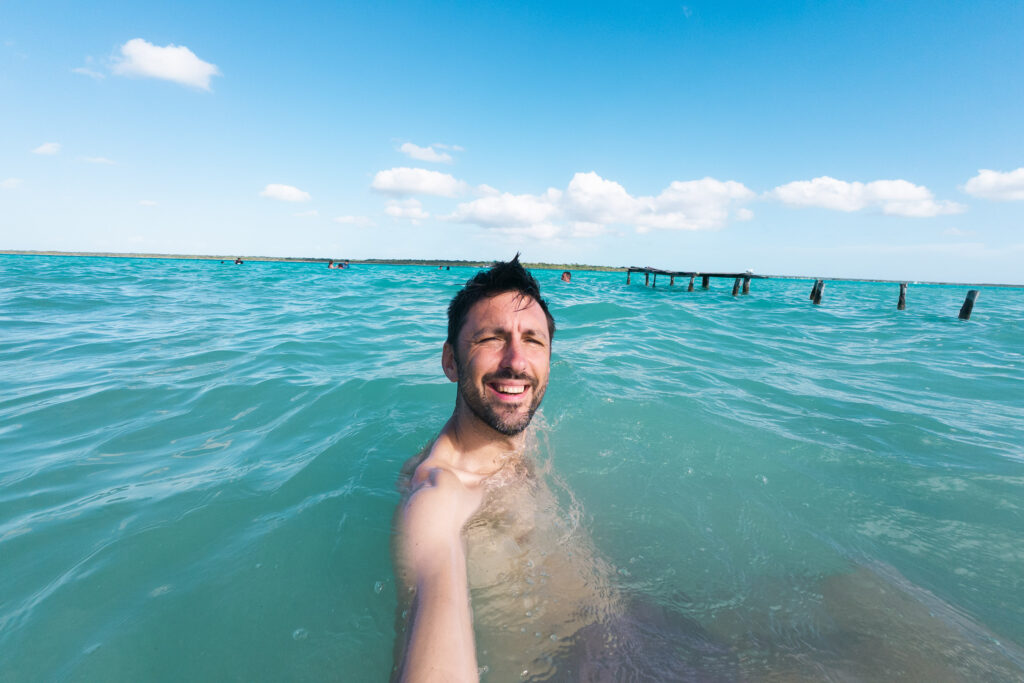
Every time I gazed upon the intensely cyan waters or felt the soft white sand floors under my feet, Bacalar would trick my brain into thinking I was in some beach paradise on the Caribbean coast.
It almost is, but not quite.
This laidback town is, in fact, located beside an enormous lagoon, connected via a narrow umbilical channel known as the Canal de los Piratas to another lagoon, which eventually (about 20km or 12 miles further) flows into the Caribbean Sea.
Shielded here from the unsightly sargassum that often afflicts the beaches of the Riviera Maya further north, Bacalar has become an increasingly popular destination in recent years.


It may lack genuine beaches, but it hosts a variety of wonderful water activities in a stunning location far from the crowds. While I wouldn’t go so far as to call Bacalar a “hidden gem” (since it’s definitely on the travel map), it’s a much more low-key alternative to the mass-scale tourism found around Playa del Carmen or Cancun.
I loved my time in this lagoon-side ‘beach town without a beach’ — its relaxed atmosphere, trendy yet unpretentious restaurants, and its gorgeous no-filters-needed waters that make you almost feel like you’re on a Caribbean island.
Here’s everything you need to know to make the most of your visit, including many tips and details you won’t read anywhere else!
Where to stay in Bacalar
Instead of starting by listing all the activities, let me first give you some tips on where to stay, since this will actually have a huge impact on your experience.
Despite being relatively small (having about 12,000+ inhabitants), Bacalar offers an abundance of accommodations, ranging all the way from swanky lagoon-front palapa villas to functional hostels with basic dorms.
But regardless of your preferred style of digs, where to stay essentially boils down to one essential choice: whether to stay on the lagoon or inside the town.

Staying inside the town has the major advantage of offering much lower prices. Even by being a few streets inland you can spend easily half as much as being on the lagoon. You’re also within walking distance of cafes, bakeries, and restaurants.. The inland hotels and hostels also more commonly feature a swimming pool, giving you an extra option for cooling off apart from the lagoon.
A nice small guesthouse, highly-rated while being friendly on the wallet. A stone’s throw from the main square.
Small-scale hotel with a jungley vibe and a garden with pool. The free bicycles let you get around town without needing taxis.
Staying alongside the lagoon can be spectacular, though it will also cost you more. Lakeside property just doesn’t come cheap and this is reflected in the hotel prices. However, if you’re not too taken aback by spending at least or so per night, you’ll surely find it worth it. The lagoon is the central feature of Bacalar after all, so being literally on it is experiencing it to its fullest.
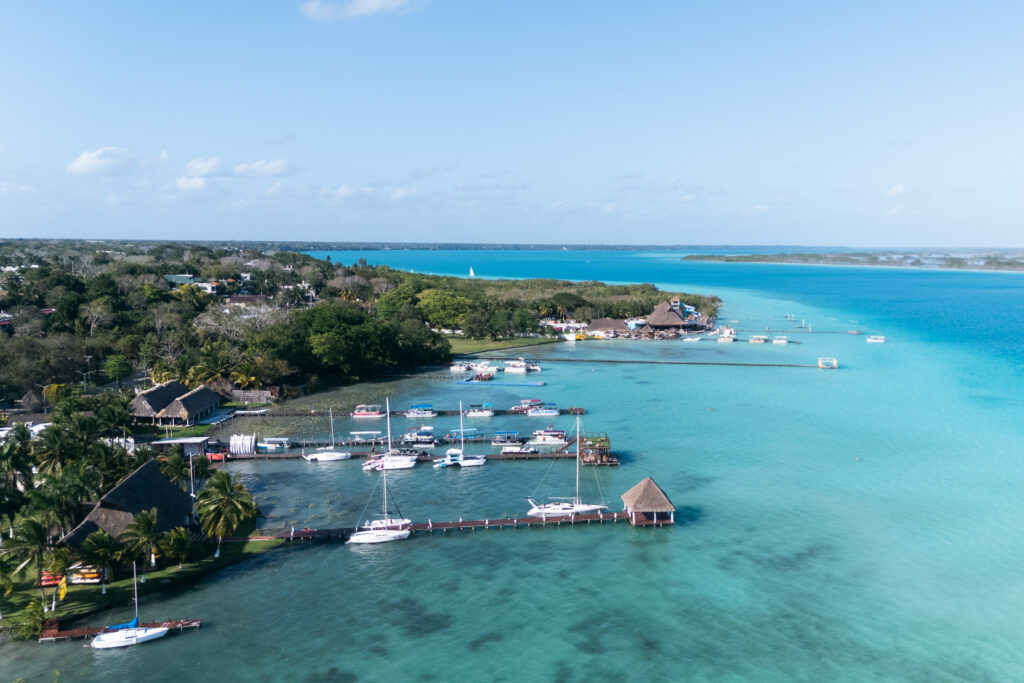
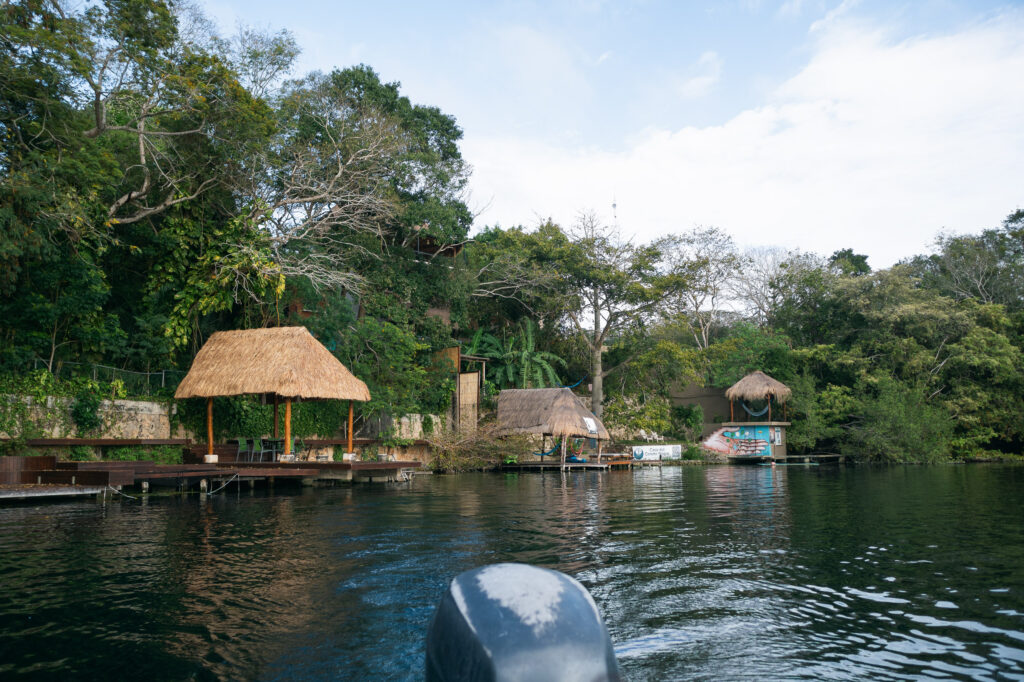
For this reason I decided to stay in Casa Lamat, a soulful lagoonside eco hotel with its own private dock that I highly recommend. It’s on the northern edge of town where you feel like you’re in the jungle, while still being just a 15 minute walk to the center (or 15 minutes from the bus stop).


Another reason I chose Casa Lamat is how serious they are about sustainability, running entirely on solar power, using biodegradable soaps, and having their own wastewater management. Having heard reports of tourism straining the local ecology, I really appreciated this hotel going to great lengths to minimize its impact.
I had a fantastic time lazing on the dock with a cold beer, chatting with other guests over breakfast (something made easier by everyone sitting at one big table), and swaying in a hammock on our front porch while listening to the chattering tropical birds.
Eco-friendly hotel, premium but rustic and with lots of soul. This is where I stayed personally and what I recommend!
For a more modern vibe with lagoon access, infinity pool, and private dock.
Being right on the lake gets pricey but this is the one exception I found! A hostel right with amazing lagoon views and private dock.
Overall my recommendation is to stay alongside the lagoon if you can. The hotels and villas often come with a private dock, so you gain your own private access to the water, often with kayaks or SUP boards available directly from your accommodation.
Public access to the lagoon is somewhat limited in Bacalar, so having direct access is a big plus, not to mention having your own morning and sunset views of the lagoon (the public cenotes and ecoparque mostly close at 6pm).
If you decide to stay in the town, then this is also still a good option and potentially a cost-saver. I found essentially all of Bacalar to be pleasant, spacious, and green, feeling almost like one big leafy suburb — the busy national road bisecting the town being the only exception. I suggest anywhere east of the 307 road for a calm and central stay.


What to know about Bacalar
Before I dive into the things to do, I’d like to give some context that will help you understand Bacalar as well as fine-tuning your expectations before you go.
Bacalar Lagoon almost lost its color
Due to varying depths of the waters and the white calcium carbonate bottom, Bacalar is famously known as the “lagoon of the 7 colors” (well, different shades of blue, turquoise, and emerald to be precise).
But as photogenic as it looks, its splendor was almost lost forever. In 2020 a tropical storm hit the region, kicking up sediment and triggering massive algae blooms, which turned the entire lagoon brown.
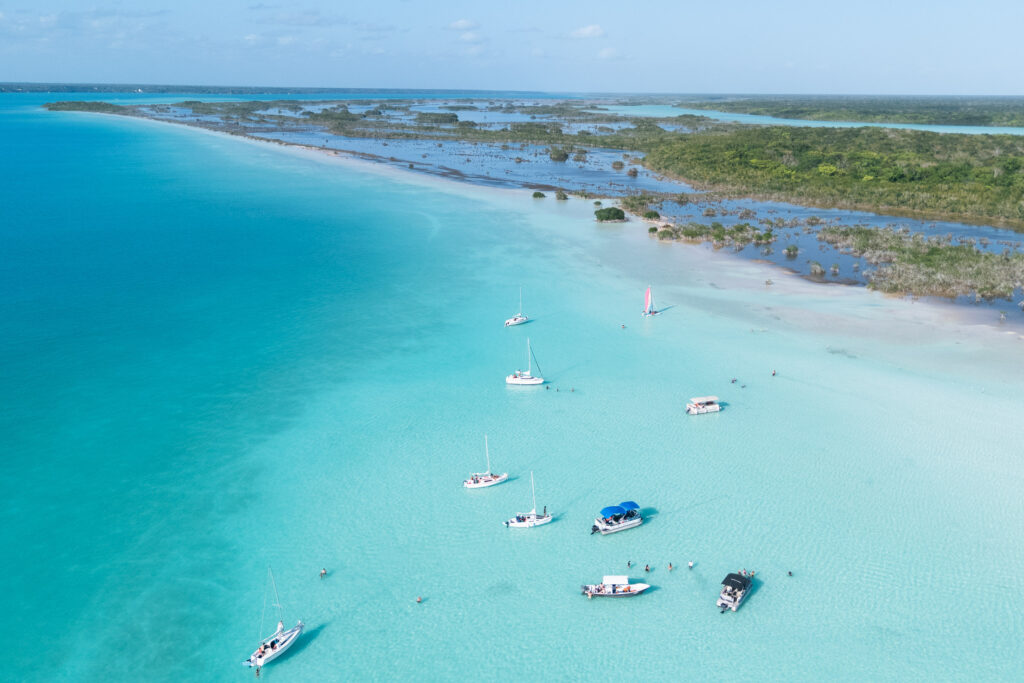
Locals hoped it would just wash away quickly, but it persisted for an entire year, prompting fears that the lagoon could permanently change. This crisis prompted a massive push for nature conservation.
There are now some ⚠️ important rules:
- Don’t use sunscreen before going into the water as it can seriously damage the ecosystem. Even ‘reef safe’ sunscreen may still have negative effects. There is a total ban in Bacalar.
- Don’t touch the stromatolites. What may just appear to be yellow ‘mossy rocks’ are actually home to colonies of rare cyanobacteria. You’re not to touch them or stand on them.
- Don’t enter the mangroves. They play an essential role in cleaning the lagoon and are essential wildlife habitats. At key sights like the Canal de los Piratas, rope fences mark the lines where you shouldn’t cross.
The environmental messaging is encouragingly very strong in Bacalar, with signs and tour guide instructions offering constant reminders. I can’t say whether this is also always followed or enforced, but there is at least a strong intention to manage tourism impacts in Bacalar.
The lagoon closes on Wednesdays
On a related note, one pertinent fact that I didn’t see mentioned anywhere before I visited is that the whole lagoon closes to all motorized boats and group tour activity involving boats every Wednesday. This is to give nature a break and let the lagoon rest.
You can still use Wednesdays to swim, kayak, or SUP (these are still allowed). You can also explore the town or take a daytrip to the Mayan ruins. But if you have only one day in Bacalar, you might not want to make it a Wednesday. Taking a boat trip was my favorite activity — but more on that later.
Pirates once raided these waters
Although Bacalar only landed on the travel radar within the last few decades, the history here goes way back.
First settled in pre-Hispanic times, Bacalar was known as “the birthplace of heaven” — a name inspired by the otherworldly colors of the lagoon. In 1543 the Spanish colonized the town, and its proximity to Honduras and other Central American nations made it a busy trading hub.

That prosperity came with a price. Pirates frequently targeted Bacalar for raids — not for gold or jewels, but for something arguably more valuable at the time: palo de tinte, or logwood, used to dye clothes black, purple, and blue. Incredibly, a single shipment could be worth more than a year’s worth of ordinary cargo.
Buccaneers including Francis Drake and Henry Morgan were among those who prowled these waters, entering via what is now known as the Canal de los Piratas. The small fort you’ll find near the main square was built in 1733 specifically to put an end to the plundering.
Those rocks… are actually living beings
One of Bacalar’s biggest wonders can very easily pass you by if you don’t know what you’re looking at.
Dotted around the coast are what appear to be yellowish rocks. But these stromatolites are not just rocks. They’re actually alive and well given that their layers are slowly being formed from the cyanobacteria which are found within.
They are the oldest-known living organisms on earth, with the earliest fossils dating back over 3 billion years (!).
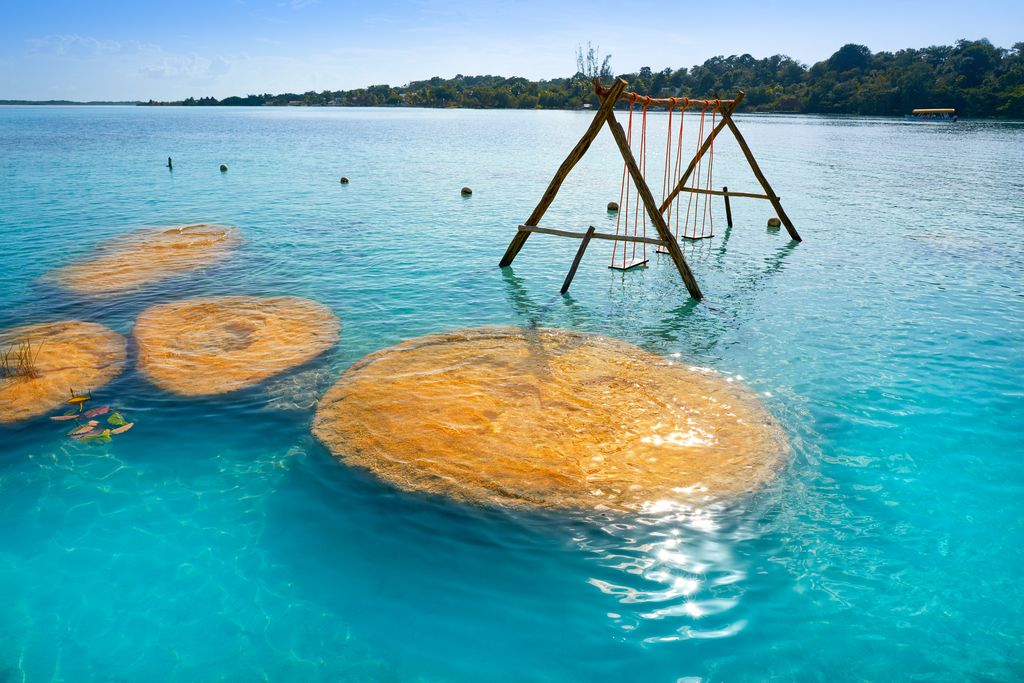
Stromatolites look like small rocky mounds that are found within the Bacalar Lagoon, and there are various places where you can get up and close to them. The most popular place is Cenote Cocalitos, however, you can also find many of them along the area known as Los Rápidos, which is a natural lazy river.
Since these are incredibly fragile bacterial colonies, you should not touch them or stand on them as this can easily cause permanent damage to structures that took thousands of years to form.
Cenotes in Bacalar are different
Several cenotes (limestone sinkholes) are dotted around Bacalar. They’re worth visiting, but they are not what you may expect from other cenotes further north in the Yucatan Peninsula.
Unlike cenotes that went viral on social media like Suytun or Ik Kil, here they are not enclosed inside caves or caverns, so from the surface they will just seem like small lakes or bays.
While browsing Google Maps I read a few outraged reviews along the lines of “how dare they call this a cenote!!”, but this is just based on a misunderstanding.

The cenotes in Bacalar are, in fact, very deep sinkholes. Cenote Negro even plunges down 70m deep into the earth. Knowing this and noticing its much darker color contrasted against the turquoise waters of the lagoon, you might appreciate them a bit more. Just expect them to be open, deep-water pools.
Cenote Azul is unconnected to the lagoon, so it’s a bit more clearly defined against the surrounding landscape, looking more like a lake. Cenote Cocalitos is also distinguished by having many stromatolites, making it different from your typical cenote.
Is Bacalar safe? A local told me “you can walk around town alone at 3am and nothing will happen”. Perhaps a slight exaggeration, but Bacalar has a great reputation for safety.
Are there ATMs? Yes, there are many. Just avoid BBVA – they are known to charge huge fees. They are usually more reasonable at HSBC and Banco Azteca. Card and contactless are widely accepted, but it’s still useful having cash as a backup.
When to visit? Dry season from December until April is ideal, though the peak of high season is Dec 20 – Jan 10, when hotel rates can easily double. June to September is the off season; local guides told me there are almost no visitors during this time.
How do you get to Bacalar? Direct coach buses from Tulum and Playa del Carmen drop you off at the bus stop here. Bacalar is also on the Maya Train route, though the station is about an 8 minutes’ drive outside of town, necessitating a taxi.
Things to do in Bacalar
Alright, now let me share how you can best fill up your days in Bacalar.
Most activities are water-based so you can honestly spend much of your time just relaxing, but there are several active sightseeing spots nearby as well.
Kayak or paddle-board the lagoon
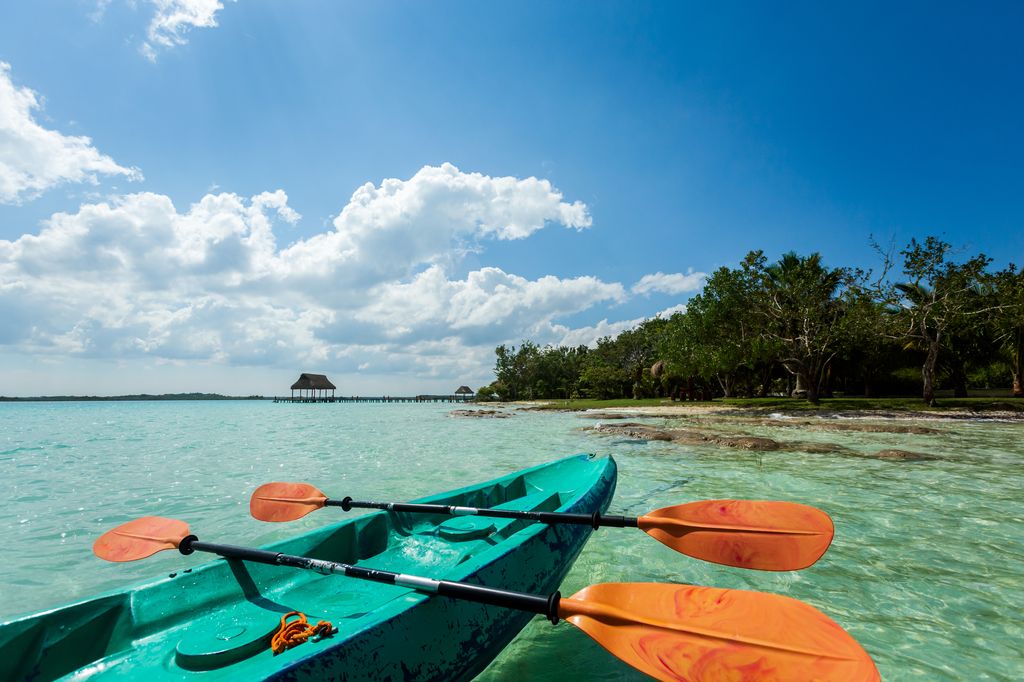
The most obvious and rewarding activity in the lagoon is to paddle around it, either by kayak or SUP board. Some of the hotels rent out the boards and boats, but you can also join an organized tour. I especially recommend this sunrise paddleboard experience with breakfast on the water.
Seeing the lake during the early hours is one of the most memorable experiences you can have in Bacalar, and I highly recommend waking up at least once during your visit to witness it. It’s even better when experienced floating around along its jungly fringes.
Setting off in the morning, your guide will take you to the very best spots of the lake to watch the sunrise, as well as visit places that can only be visited via the water, such as the Cenote Negro.
Visit the Canal de los Piratas
Located on the adjacent shore facing Bacalar, the Canal de los Piratas is a narrow passageway of water connecting the lake to the surrounding region.
In ancient times it was an important point of trading between the Mayans who resided here along with various other civilizations located further south, in the region which was once called Mesoamerica (areas which are known today as Guatemala and Honduras).
Officially the Salamanca Canal, it earned its infamous nickname during colonial times as many pirates once used this route when they attempted to lay siege on various parts of Southern Mexico (such as Bacalar).
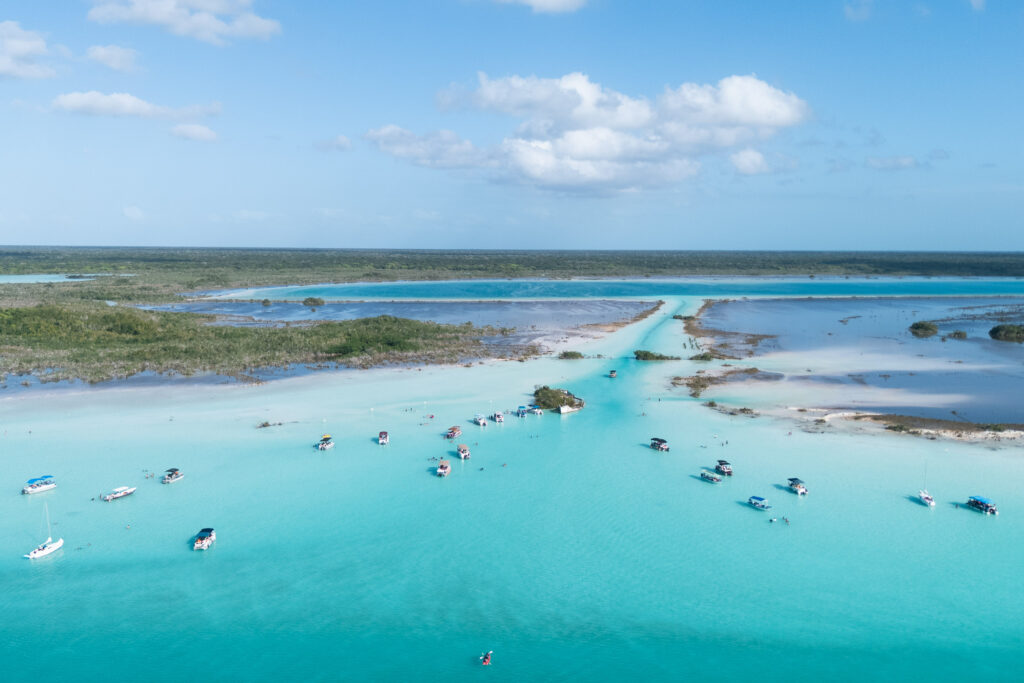
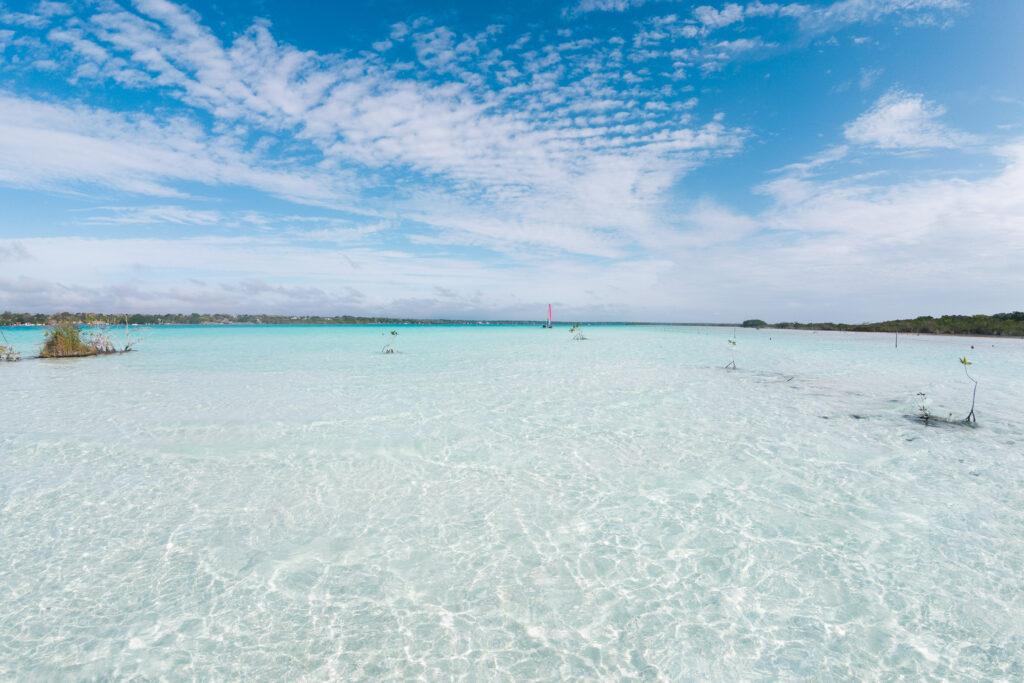
Today it’s unlikely we’ll cross paths with any marauding raiders, however, you can instead appreciate this beautiful, thin stretch of river, ideally visited as part of an organized boat trip. The lagoon here is surprisingly shallow, letting you easily wade around the glittering waters.
The floor’s limestone sands here are so fine that they feel ticklish under your feet! It’s an unusual sensation that adds to the surreal cyan and white surroundings.
A boat tour around the lagoon is a must and will include the Canal de los Piratas. Just remember the tours don’t go on Wednesday, when nature gets to rest.
This is the best activity I did in Bacalar, taking you to the Canal de los Piratas, two cenotes, the “bird island”, and several other sights in one 3-hour trip.
The tour meeting point is Casa China, a restaurant directly on the lagoon. Don’t worry if you see many people gathering here — they have multiple boats, so everyone gets split up into small groups. Beers, fruit, and refreshing hibiscus juice are included on board.
Relax by the cenotes
As I mentioned, the cenotes around Bacalar aren’t really caves or visible caverns, but they do provide excellent surface-level swimming holes. Most of them are just a 5 to 10-minute drive from the town center.
- Cenote Esmeralda and Cenote Cocalitos are connected to the lagoon, appearing like semicircular bays even though they’re circular sinkholes beneath the surface. Esmeralda is a good cenote to see stromatolites (just keep your distance from them as to not damage them). You can access it via Casa China. Both cenotes cost to enter.
- Cenote Negro is only accessible by kayak/board/boat. It’s beside private property and also has the appearance of a bay.
- Cenote Azul (recommended) appears as a fully circular lake and is publicly accessible. It’s arguably the best cenote to relax and swim. There are some small shops and a restaurant. You need to pay a small entrance fee of .
While the cenotes don’t quite have the wow-factor of the caverns found elsewhere in the Yucatan, they are good hang-out spots — in addition to the public docks.
Walk the Ecoparque boardwalk
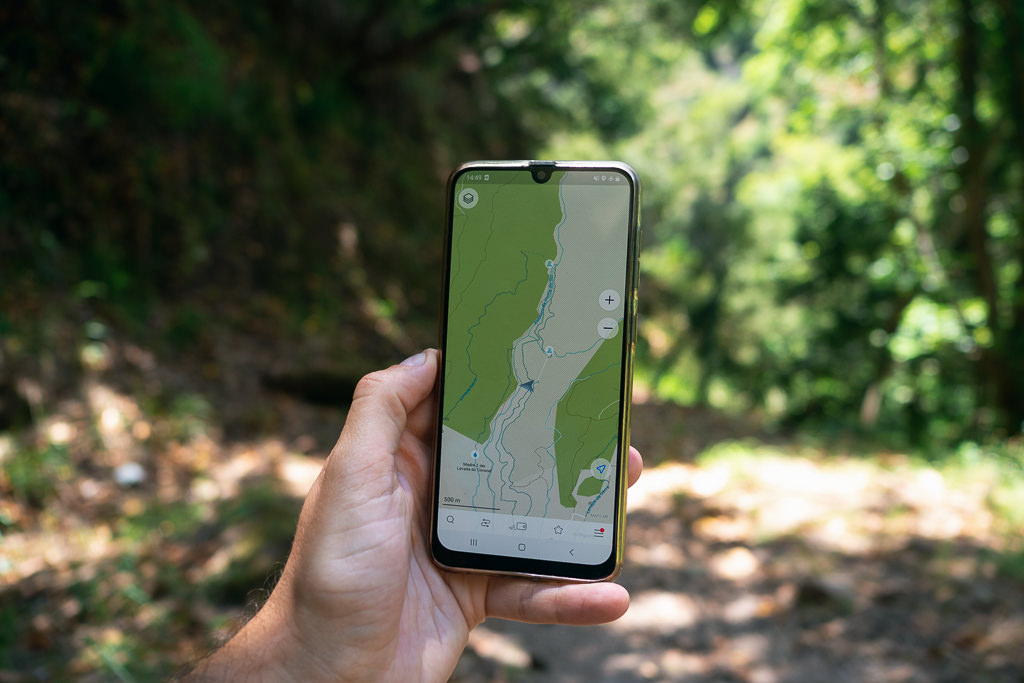
When I first surveyed Bacalar on my favorite map app (Organic Maps), an unusual square shape stood out — a perfect square that overlapped the eastern shore of the town. For a moment I thought it was some kind of error, but it is actually the Ecoparque boardwalk.
For a entrance fee you can walk among a protected mangrove and jump in for a swim. You can see lots of interesting wildlife, especially if you go shortly before dusk. This includes crocodiles, which may be a bit unnerving, but you can still safely swim in the waters here during the day. (The crocodiles are inactive during the day and they are anyway rather small.)
Just parallel to the entrance is a public dock you can access without paying. This gets a little busy, but it’s one of the several swimming and hang-out spots that aren’t part of a hotel, bar, or beach club.

Relax at the Balneario Ecológico
Not to be confused with the aforementioned boardwalk, this is simply a path leading to essentially a tiny beach (entrance costs ). There are no facilities nor any docks here — just a gap in the mangrove giving access to the water — but I highly recommend this spot especially if you’re with children.
I went to the Balneario Ecológico on the recommendation of my hotel owner who always goes here with his small kids, and it was a great tip. My 4-year old daughter was often intimidated by the deep waters of the cenotes, but she loved splashing around the shallower waters here.
Whether you’re a family or not, it’s a great little hidden spot in nature.


Dive into the restaurant scene
Bacalar is bursting with great places to eat, with prices much more reasonable than the Riviera Maya. Many of them are trendy and offer some twists beyond the standard menu items, though without being overly exclusive or upscale, which fits the vibe that I personally most enjoy.
If you’re looking for cheap eats then there are also plenty of taco places, a couple of food trucks, and local “meal of the day” type of places as you get further from the main square.
I had excellent meals at all of the following places:
- Enamora Restaurante & Café – My favorite place for breakfast and brunch offering a mix of Mexican and Nordic-inspired options. The crispy chicken salad with mango is delicious and my daughter was thrilled with the meatball sandwich, having earlier confessed missing meatballs from home during our travels. While you wait for your order, don’t miss browsing the integrated art shop.
- Noru Bacalar – Excellent Mexican lunch/brunch place, turning into a Japanese sushi restaurant at night. Lovely jungley terrace beside the lagoon where you’re surrounded by trees wrapped in giant pothos leaves. The ceviche and pulled pork tacos are superb!
- Mar y Sol – Classic Mexican dishes at affordable prices. This place is not found on Google Maps! Look for the sign “Comida economica” opposite La Kinta cafe. No alcohol is served but they let you bring in beers bought across the street. A great down-to-earth, family-run joint.
- Tigre Pétanque – Offers a mix of international options including hummus, falafel, burgers and tacos with a leafy garden terrace.
- La Oaxaqueña – For a different twist on the usual Mexican dishes, head here for some classics from the Oaxaca region. Sadly they have no moles but they do have many versions of the pizza-esque tlayudas.

Visit the San Filipe Fort
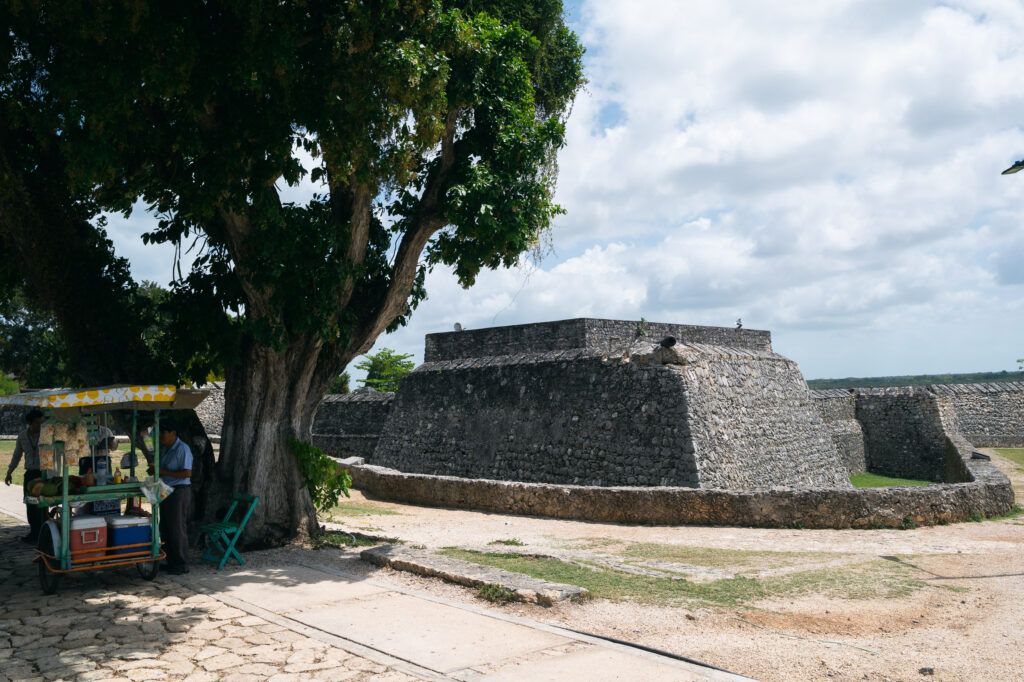
The San Filipe Fort is likely one of the first landmarks you’ll see in town, being located right next to its main square. Constructed in 1733 by the Spanish, it primarily served as a defensive structure to alert of any incoming attacks from pirates or opposing factions that arrived from the coast.
While the fort is not particularly huge, it is well-preserved and has a small informative museum with English and Spanish signage. Since it’s so easy to tick off the list while you’re in town, I highly recommend popping by.
Something you’ll learn about is how the fort was meant kept pirates from stealing priceless wood (yes, wood!). A single shipment of logwood, which was used for creating natural dyes at the time, would be worth more than a year’s worth of other cargo. Walking around you can see the 30+ cannons which were once used to fend off attempted sieges.
Browse the art collective gallery
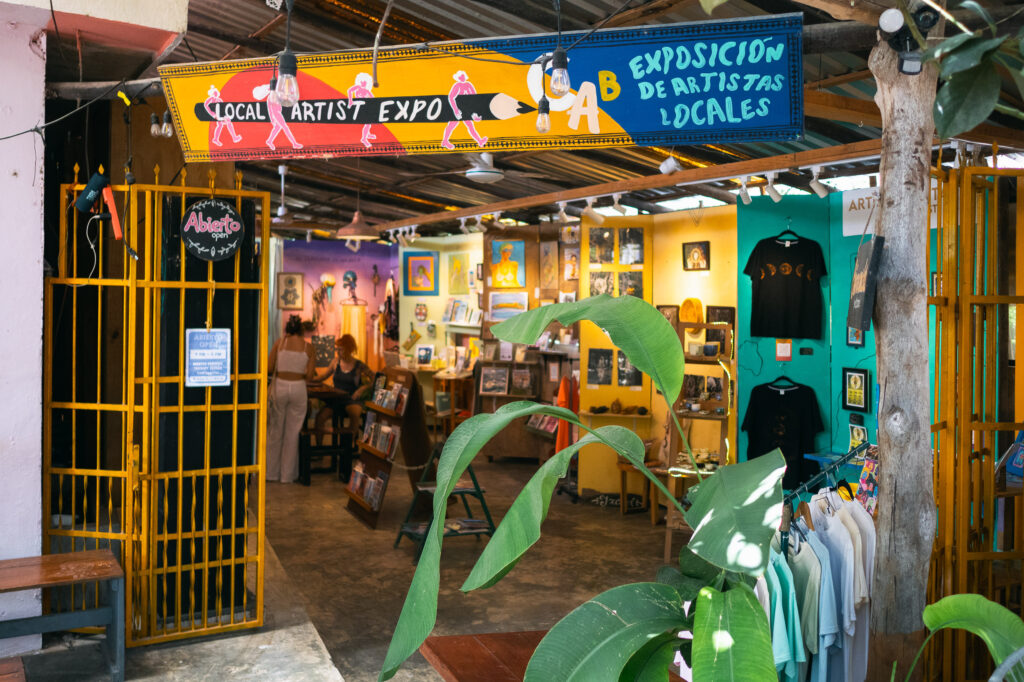
Hidden inside Enamora, a wonderful cafe and restaurant, is an integrated art space run by CAB Colectivo, a group of artists in Bacalar. I hadn’t seen this mentioned anywhere and was positively surprised when I stumbled upon it.
If you’re unexcited by the typical souvenirs and products you find in shops and market stalls in Mexico, then you will surely love this venue. It’s filled with hand-made and custom artworks, prints, and apparel with unique designs.
It’s a great place to browse while you await your breakfast or brunch order at Enamora, which may have been my favorite cafe in Bacalar. It serves Mexican classics as well as some Swedish-inspired options.
(Re)consider visiting Los Rápidos
About 20 minutes south of Bacalar, this narrow canal lets you float down either swimming or by kayak. Los Rápidos became a major viral sensation on Tiktok and Instagram for its bright turquoise waters with contrasting layers.
The idea of floating down a scenic canal is fantastic, though sadly the place has the reputation of being overcrowded and being a “tourist trap”. There are also reports of this place not adhering to Bacalar’s ecological rules, letting visitors use sunscreen and with many stromatolites having already died off.
I’ve heard from some travellers who went first thing in the morning and had a good experience. However, after several negative takes I opted to give this place a pass.
I may be wrong in skipping it, but I would recommend checking recent reviews to get a feel for whether this place is being properly managed.
Discover the less-visited Mayan Ruins
It’s a big mistake to think Chichen Itza is the only Mayan ruin worth seeing. Far from the crowded, almost theme-park like experience, the smaller Mayan sites offer a very different and much more intimate experience.


I had already seen several such alternatives near Merida and Valladolid, so I didn’t take the chance to see more of them in Bacalar — but there are two ruins in particular to be aware of. But are about an hour’s drive away, so if you don’t have your own car, I recommend visiting them as part of an organized day trip.
- Kohunlich: Set deep in the jungle about 65 km west of Bacalar, Kohunlich is famous for its Temple of the Masks — a pyramid adorned with enormous stucco faces of the Maya sun god. They’re said to be among the finest examples of early Classic Maya art. At this remote site, howler monkeys can often be heard from the canopy as you explore.
- Ichkabal: Opened to the public only in 2025, it’s one of the newest archaeological sites you can visit in the Yucatán. Located less than 50 km from Bacalar, it’s home to the second tallest Maya pyramid in the region, rising about 45 meters above the jungle floor. While many parts are still unexcavated and hidden under the jungle, Ichkabal gives you the chance to be among the first tourists to see a recently unearthed structure. It’s an example of a pre-classical Mayan site — being over 2 millenia old. This video gives a great tour of the site.
Be amazed at the butterfly sanctuary
I stumbled upon this wonderful hidden gem about 30 minutes north of Bacalar. If you have your own vehicle then it’s worth visiting, especially as a stop on the way north to Tulum or perhaps Mahahual.
Otoch Peepen means “House of the Butterfly” in the Mayan language. This butterfly sanctuary is run by a local family who will show you the process of nurturing the butterflies through every stage until fully grown.
When I first stepped into the large greenhouse space I was blown away. So many huge butterflies fluttered around that I almost didn’t know where to look. The enormous creatures were rather curious, first landing on my camera, then on my shoes and finally my shoulders.
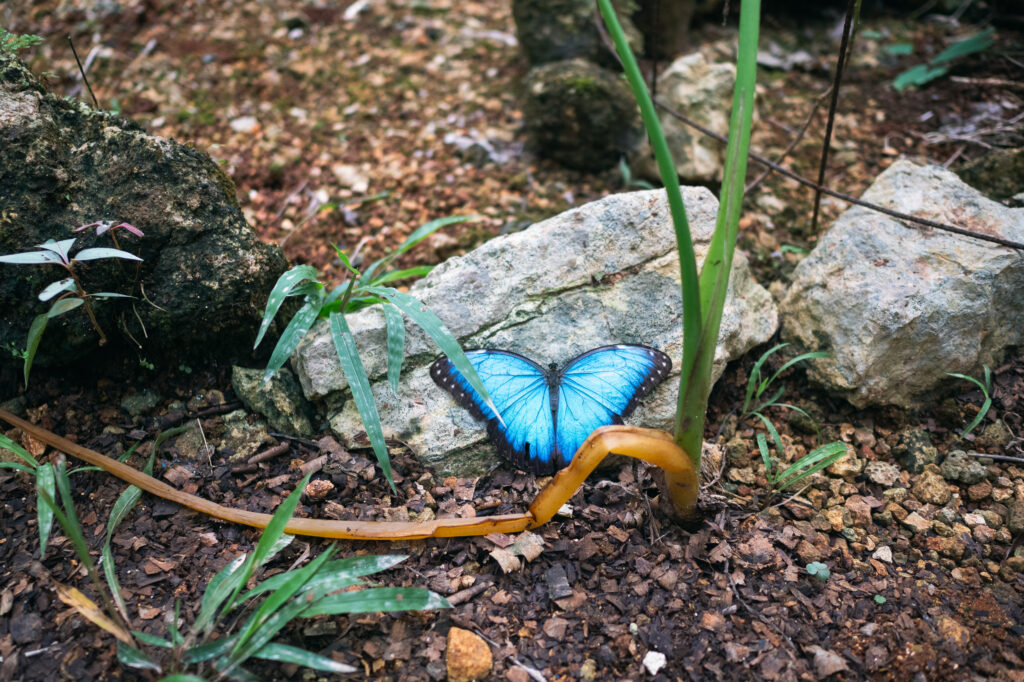


The species kept here are among the largest in the world, including iridescent Blue Morpho that get up to 8 inches or 20cm wide.
I’ve seen a few butterfly gardens in my travels but this one was certainly the most impressive. The private tour costs per person, which helps their (government-accredited) conservation mission.
They also keep several adopted rescue animals including (on my visit) a deer and a spider monkey. It’s a great little spot to bring kids, although the butterflies were so big that my 4-year old daughter was honestly a little freaked out — a reaction I had not quite anticipated! To me, it was simply magical and worth spending 20-30 minutes if you’re near.
Where to go next
I ventured an hour north for some snorkelling in Mahahual, but I would honestly not recommend this. Mahahual may seem like a calm village but it’s actually a major stop for cruise ships that regularly unload swarms of tourists onto its beaches.

We tried resting on some lounge chairs under the swaying palms but were interrupted literally every 3 minutes by someone selling cigars, hair braids, henna tattoos, fridge magnets, or mariachi hats — all for extortionate prices quoted in US dollars. It’s a stressful and overcommercialized place… if you’re an independent traveller, avoid.
Fortunately there are much better places to go. The first major travel node north is Tulum, which connects directly by bus from Bacalar. Just 40 minutes south is Chetumal, itself not noteworthy, though it’s the perfect waypoint to Belize. Ferries depart here to Caye Caulker (3 hours), a key node on the Central America backpacker route, from which you can dive further into Belize via San Ignacio and onwards to Flores in Guatemala.