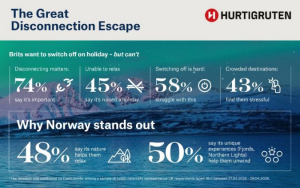
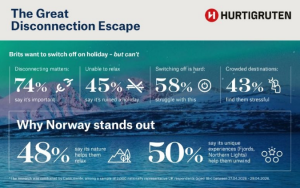
New research from Hurtigruten, the leader in iconic Norwegian coastal voyages, has reveal that almost 60% of Brits struggle to disconnect whilst on holiday, despite 74% knowing the importance of being able to unwind when they are away.
The study of 2,000 UK adults found that not being able to relax on holiday had ruined their trip (45%) and many would go out of their way by trading convenience to travel to somewhere quieter (55%) if it meant they could fully disconnect.
Chartered psychologist Dr Audrey Tang says: “Holidays are associated with helping us live a healthier overall lifestyle, as well as positive physical changes for both mind and body. The slower pace of life when on holiday reminds our nervous system that it’s okay to rest, which can free up time and space to engage with healthier behaviours, and give space for your mind to reset…and even enhance your performance when you return to work!”
Can’t switch off from the 9-5
With travellers taking up to 1-2 days to relax on holiday (31%), many just can’t shake the temptation to check their phone. Over two-thirds (69%) scroll through social media or check messages and emails at least once a day, and nearly a third (34%) confess to checking work emails. Shockingly, 13% felt expected to respond to work emails whilst on holiday.
What helps us disconnect
Relaxing by the sea (56%), spending quality time with family and friends (50%) and exploring local culture (47%) are the top three types of activities that help us to switch off while on holiday.
Beat the crowds
With 52% avoiding destinations they expect to be too crowded, and 43% of those most frustrated by overcrowding saying it makes them feel stressed, it’s no surprise that 85% of those who’ve experienced this say it makes it harder to disconnect. As a result, travellers are turning to destinations such as Norway as a place of true escapism.
When asked why Norway could help them disconnect, 50% of Brits pointed to its unique experiences such as the fjords and Northern Lights, while 48% cited its nature and landscapes. A further 42% said Norway’s slower pace of life would help them switch off, while 37% liked the idea of fewer crowds.
“We know that for many people, switching off is easier said than done,” said Hayley Moore, VP Sales & Marketing at Hurtigruten. “This research confirms just how many of us carry work, our phones and the stress of everyday life with us when we travel. Norway offers something different: space, nature and a slower rhythm that makes it easier to truly unwind. A Hurtigruten voyage is designed to help guests experience that feeling from the moment they step on board.”
For more information about Hurtigruten and Norway coastal voyages, visit www.hurtigruten.com.
To help Brits disconnect whilst on holiday, Psychologist Dr Audrey Tang, has provided her top 5 tips:
It is understandable that it can be hard to “switch off” – especially when you have huge responsibilities, however, sometimes the solutions are practical rather than psychological!
If you need some level of work-based contact – manage it!
Make sure the person in charge is fully briefed, or that your out-of-office message clearly explains where you are and any time zone differences that may affect response times. It can also help to set a specific day or time to check in, and then stick to it, so you can stay fully present and avoid work encroaching on your break.
Know what kind of “switching off” you need!
Sometimes it can be hard to “relax” on holiday because we don’t always know what type of relaxation we need. We might need physical rest because our body is exhausted, in which case sleep or a ‘chill day’ is the most effective choice. If we need mental rest, then sleep may not come and forcing it can be stressful – instead find an activity that engages the brain such as a day trip or a new skill that allows you to take your mind off work, while directing it elsewhere. Alternatively, you might need social rest so build in some time alone or maybe it’s a digital rest – so don’t watch TV or use your screen, embracing being out in a new environment.
Set a clear intention to be fully present in everything you are doing while on holiday
If you catch yourself thinking about work, actively remind yourself to be fully present in what you are doing and who you are doing it with. You don’t necessarily need to do formal mindfulness exercises – but work to observe what is happening around you and take note of the experiences of all your senses. A simple trick is to call yourself back to something you can actively engage with via any one of your senses anytime your mind wanders back to the office!
Admire the beauty and vastness of nature
Humans are biophilic so we naturally feel better when we are in view of, or experiencing natural qualities – wood, slate, stone, water and so on have a calming effect on body and mind. Plus, giving yourself permission to take a moment to stand and allow the beauty of the stars, the sea, or the rolling hills can bring an additional sense of wonder and magnitude…which in turn helps offer a new perspective when you consider the vastness of the world and how small we really are. This hopefully helps us recognise that, at least metaphorically, any problems we may have are likely smaller than we realised.
Leave a buffer day for when you return
People joke about needing a holiday from a holiday – but having a day to prepare to return to work can give you a little extra breathing space – and stop work-think creeping into the last few hours of your break. Use the extra time to get your clothes out or make lunch so you can start your first morning back well. Resist the temptation to “check in” with the office, remind yourself that if something has waited this long, it will likely wait another 12 hours.